Blockchain’s 2026 Breakout Belongs to Banks, Not Crypto
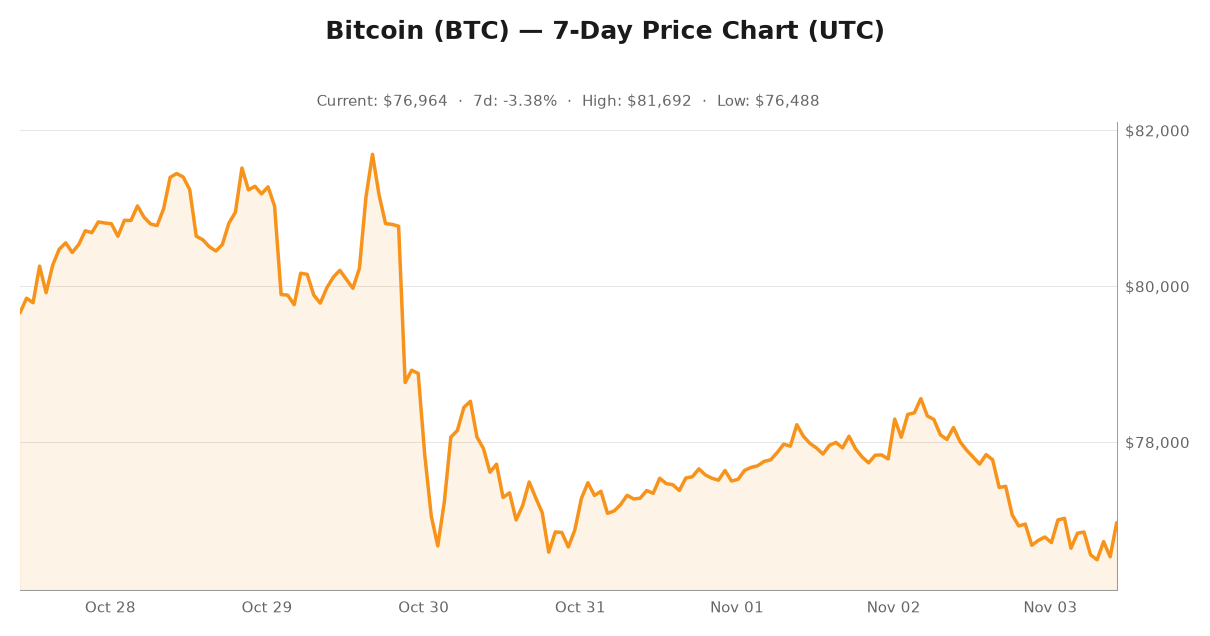
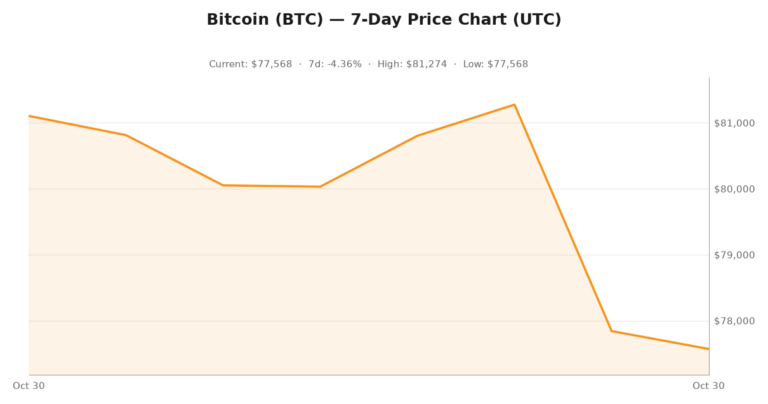
Bitcoin traded below $77,000 on Tuesday morning, logging a fifth consecutive weekly loss and sitting roughly 39% below its October 2025 record near $126,080. The Nasdaq 100 slid into a correction, chip stocks kept bleeding, and volatility desks flagged a bump into the US midterms. It would be easy to conclude that crypto is simply having a bad quarter.
That conclusion misses the more interesting story running in parallel. While Bitcoin drifted sideways to lower, the last ten days produced the most concentrated run of institutional blockchain announcements of the year: a bank launching tokenized deposits for corporate clients, a stock exchange moving shareholder voting onto blockchain rails, a central bank extending tokenized settlement around the clock, and a wave of rights holders pushing back against permissionless tokenized versions of their brands.
Here is the contrarian read. Blockchain’s breakout year is real, but the value is being captured by banks, exchanges and infrastructure incumbents, not by the crypto-native projects that spent a decade telling everyone they would own this moment.
The week blockchain stopped being a crypto story
Five announcements between November 1 and November 3 make the pattern hard to ignore:
- Standard Chartered debuted tokenized deposits in Hong Kong for corporate clients, according to CoinDesk. The deposits are issued by a bank, held in a bank’s structure, and cleared through a bank’s own books.
- The Hong Kong Monetary Authority is moving tokenized settlement into 24/7 operation and plans to bring regulated stablecoins into tokenized government bond trials, while HSBC says its RedCoin stablecoin has passed 50,000 users, Cointelegraph reports.
- The New York Stock Exchange tapped Broadridge to move shareholder voting onto blockchain rails, per CoinDesk. Shareholder records, not token prices.
- tZERO, a tokenization software company, agreed to go public through a $350 million SPAC, per CoinDesk.
- metals.io issued tokens backed by 25 tonnes of physical copper stored in Germany, also reported by CoinDesk.
Read that list again and notice what is missing. Not one of these deployments requires Bitcoin, and only some of them require a public blockchain at all. Every one of them requires a licence, a balance sheet and a legal right to issue the token. That is the difference between a blockchain pilot and a blockchain business.
What the numbers actually say
Tokenization’s growth shows up in stablecoin supply rather than in token prices. Total stablecoin supply now sits near $296.7 billion spread across 433 separate tokens, according to DefiLlama. For context, the entire crypto market was worth roughly $2.58 trillion when this was written, with Bitcoin holding 59.87% dominance and 24-hour spot volume across all assets near $68.2 billion (CoinGecko).
That means roughly one dollar in every nine dollars of crypto market value now sits in a token pegged to fiat currency rather than to a crypto asset. And most of it is not moving through a crypto-native venue. It sits in bank deposit structures, tokenized money market funds and, soon, tokenized government bond trials.
The DeFi footprint tells the other half of the story
Total DeFi value locked across all chains sits near $81.8 billion. Ethereum holds $43.59 billion of it. Base, a corporate-focused chain, holds $5.89 billion. Solana holds $5.39 billion, BSC $5.16 billion and Tron $5.12 billion. Bitcoin holds $4.09 billion, according to DeFiLlama chain data.
Let that comparison sit for a second. Bitcoin’s entire on-chain DeFi footprint is now smaller than Base’s and roughly a tenth of Ethereum’s. The chain with a market capitalization above $1.5 trillion and the strongest security budget in the industry has one of the smallest native financial applications of the major networks. If blockchain’s growth were being driven by crypto-native economics, this is not the chart it would produce.
Instead, the growth is showing up in places where blockchain is invisible to crypto users: deposit issuance, share register maintenance, settlement windows and commodity certificates. That is a real business, and it is a bigger business than the one crypto-native teams are fighting over.
The pushback is the tell
The most revealing item of the week was not a launch. It was a complaint. Nvidia, Costco and Nike joined a pushback against OKX’s ICE tokenized stock plans, CoinDesk reported. The objection is straightforward. These are rights holders, and they do not want their equities circulating on a blockchain where the issuer cannot control who holds a token, how it transfers or whether a court can compel a freeze.
This is the pattern that should set expectations. Permissioned blockchain rails scale because permission is the product. Blockchain without permission is a legal liability most large institutions cannot accept, which is precisely why the biggest deployments keep arriving as joint ventures with incumbent licensees rather than as open deployments.
The regulatory direction of travel confirms the pattern. Crypto.com said it will discontinue its consumer app in Hong Kong in February 2027, citing regulatory changes (Cointelegraph). The FATF has opened targeted reviews of crypto jurisdictions, with initial findings due in June 2027. South Korea is urging exchanges to push more customer funds into cold storage after the Binance hack, on top of an existing 80% cold wallet requirement. The Bank of Korea is surveying 31 financial institutions on how a prolonged crypto downturn could hit their balance sheets.
And this is not an anti-crypto turn. New Jersey lifted its staking ban on Coinbase and dropped a $5 million penalty, clearing the way for restored staking access in the state. Morgan Stanley cut Coinbase’s price target by 50% to $120, but on weak trading volume rather than regulatory risk. The argument in Washington is that crypto should be regulated into legitimacy, and the industry is accepting that bargain faster than most crypto-native projects would like to admit.
So what does this mean for Bitcoin?
Two things, and neither is comfortable.
First, Bitcoin is not the rail this boom runs on. Tokenized deposits, tokenized bonds, tokenized equities and tokenized commodities all settle against fiat custody and bank-issued claims. Bitcoin’s $4.09 billion DeFi footprint confirms the pattern from the other side. If you want exposure to tokenization infrastructure, a bank deposit token or a tokenized treasury product is a more direct expression than owning bitcoin, which carries no claim on any of it.
Second, this boom does not rescue the bitcoin price. Bitcoin lost 7.3% in October, which some traders are already calling “Hacktober”, and a fifth weekly decline followed. That is not contradicted by tokenization progress. Institutional infrastructure adoption and token price direction are separate variables. A bank can spend 2026 building blockchain-based settlement rails, roll them out, charge fees, and post a weak quarter for the equity that funds the project. Bitcoin meanwhile reprices on flows that left. US spot bitcoin ETFs saw roughly $515 million of net withdrawals in October, ether funds posted a record $1.61 billion monthly outflow, and BlackRock’s IBIT shed $405.3 million on Monday alone as November opened with nearly $399 million of net outflows (Cointelegraph).
One more detail worth flagging for anyone modelling this. Binance’s user protection fund now holds roughly 7,500 BTC after a 7,499 BTC transfer tied to the hack, about $580 million, which is below the exchange’s own $800 million top-up threshold with no announced timeline for restoring the fund. Balance-sheet plumbing at the largest venues is now a live variable for crypto prices, not just for crypto businesses.
Three things to watch next
- Whether tokenized equities ever reach permissionless blockchain chains. The fight between Nvidia, Costco and Nike on one side and OKX’s ICE plans on the other is the first real stress test of whether blockchain rails can be used for securities without a rights-holder veto.
- Who clears the tokenized government bond trials. If Hong Kong routes regulated stablecoins into tokenized sovereign debt, the winner is the institution providing settlement and custody, not the blockchain providing the ledger.
- Whether Bitcoin’s own financial layer grows or stalls. With Bitcoin’s DeFi footprint at $4.09 billion and network security near record levels, there is a widening gap between security and utility. Watch whether it closes in 2027.
The bottom line
Blockchain’s breakout year is happening. It is also happening to the industry that spent years preparing for it, which is the part crypto-native teams keep getting wrong. The rails shipping in 2026 are bank rails, exchange rails and regulator-approved rails, and they are built on blockchain infrastructure that crypto-native projects rarely get to touch.
The useful question for the next twelve months is not whether blockchain works. It plainly does, and it works best where institutions already run the ledger. The question is how much of the value created on those rails accrues to tokens rather than to the institutions issuing them. Right now, the evidence points clearly one way.
For readers watching the bitcoin price, keep the two stories separate. One is a repricing driven by outflows and macro risk. The other is an infrastructure cycle with real revenue attached to it. They can happen at the same time, and in November 2026 they are.