Bitcoin’s Quantum Problem Is Coordination, Not Code
Every few months the same story resurfaces in crypto: a quantum computer will break Bitcoin, and 21 million scarce coins become worthless paper. The story has been running for more than a decade, it has never once moved a funding rate, and here it is again in late October 2026 with the same fog machine.
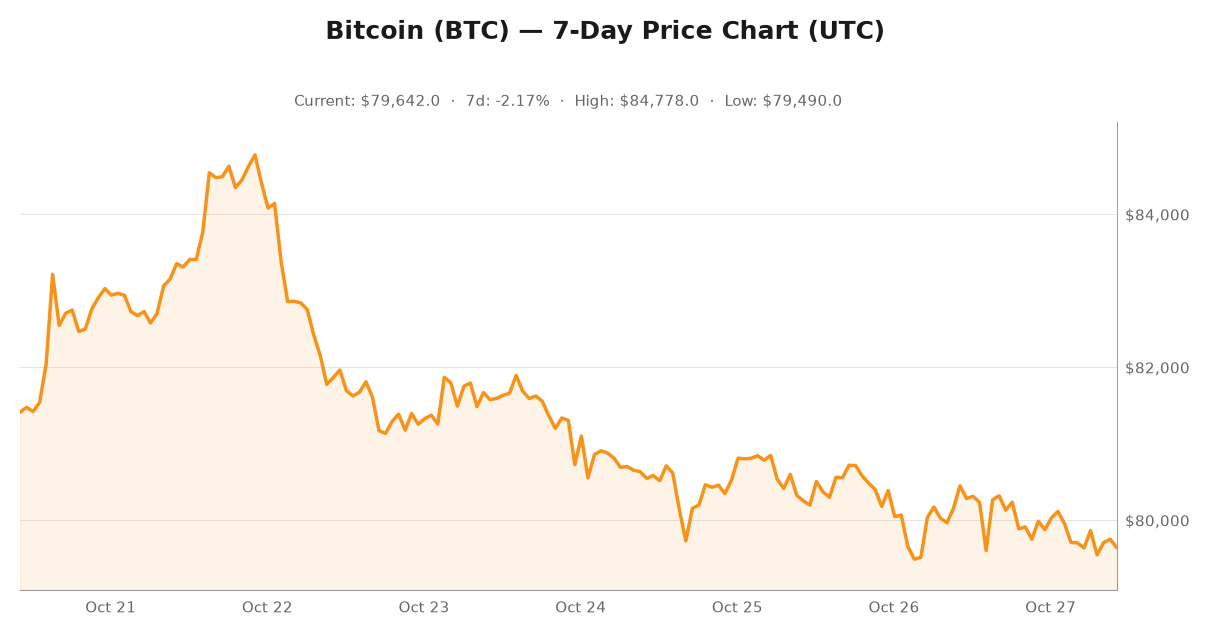
Bitcoin trades around $79,600, down roughly 2.2 percent over the past seven days, while broad risk assets line up for a volatile week. Nobody is pricing quantum risk. That is not negligence. It is a rational read on a threat with no date, no probability distribution and no deliverable. But rationality has a cost here, because the real risk in this story is not the cryptography. It is the coordination. And the coordination problem is the most underrated risk in crypto right now.
The threat is real, but narrower than the headlines
Let us get the cryptography right, because most coverage gets it wrong in both directions. Bitcoin security rests on two very different primitives, and they fail to very different degrees.
- Elliptic curve signatures (ECDSA, plus Schnorr since Taproot). These are asymmetric schemes. Shor’s algorithm runs exponentially faster on a quantum computer than on a classical one, and it breaks them completely. Not weakens them. Breaks them. Once you have a large enough quantum machine, you can forge a valid signature for any public key you can see.
- Hash functions (SHA-256, SHA-512, RIPEMD-160). These are symmetric. Grover’s algorithm gives a square-root speedup, which turns a 256-bit hash into roughly 128 bits of effective security. Uncomfortable, and absolutely not broken.
So the accurate framing is not that quantum computers destroy Bitcoin. It is that quantum computers destroy the ability to sign for Bitcoin keys that are already public, while leaving a large cohort of hashed-only addresses with a working 128-bit shield. That distinction is the whole game, and almost nobody prices it. It is also exactly why this migration is a governance problem rather than an engineering problem.
The exposure map, in numbers
Here is the part that should make you uncomfortable, and it has nothing to do with physics.
Roughly 19.3 million of Bitcoin’s 21 million have already been mined. About 1.7 million remain to be issued, and the next halving cuts the subsidy to 1.5625 BTC somewhere around 2028. Every coin in existence today sits on a public ledger, and every one of them is ultimately secured by a signature scheme that a sufficiently large quantum computer could defeat in principle.
The nuance is when the public key becomes exposed. There are three distinct paths, and they carry wildly different risk.
- Keys revealed by spending. When you spend from a legacy address, its public key is published for the first time. From that moment a Shor-capable machine could forge a signature for that key and sweep anything still sitting at it. This is the standard, well-understood exposure path, and it is also the least controllable.
- Keys that have never been revealed. If the public key has never appeared on-chain, an attacker still has to reverse the hash to find it. Grover’s algorithm makes that a 2^128 job, the same order of difficulty as any pre-quantum collision search. Not the urgent problem.
- Coinbase and mining payouts. A mining payout spends an immature coinbase output every single block. That is a mechanical, continuous leak of public keys, and it is the most under-discussed quantity in this entire debate.
Stack that against the roughly 80 million UTXOs Bitcoin carries today and the billion-plus public keys already exposed, and the unexposed cohort is not a comfortable margin. It is a shrinking one. Meanwhile the network carries well past one zetta-hash per second of security, but that security is economic, not cryptographic. It buys you time, not immunity.
There is a second, quieter problem sitting under all of this: a large share of the supply is in wallets nobody is maintaining. Our earlier work on the 11 million BTC that cannot be linked to any known owner covers part of that picture. Coins that are provably unspendable are the easy case. Coins that are theoretically spendable, sitting on hardware nobody has powered on since 2015, are the hard case, and no migration plan can help them.
Why the migration is a governance problem
Fixing this requires a consensus change. Consensus changes require that a specific list of parties agree, and the list is long, and the incentives are misaligned.
- Bitcoin Core developers must write and review code that is safe to run on six-figure hardware under adversarial conditions.
- Miners must upgrade. They upgrade for the subsidy, not for crypto hygiene, and every node software release carries its own coordination surface.
- Exchanges, custodians and ETF issuers must pause or migrate user balances and re-issue addresses, and they want a published date and a plan before they move a single satoshi.
- Hardware wallet vendors must ship new firmware with a new signature scheme, and the installed base of physical wallets in circulation is the least updateable software on earth.
- Governments and regulators have to not object to a change in how a sovereign-grade asset is signed.
- Long-term holders in cold storage have to actually move coins, or accept that their coins are only as safe as the firmware they will never update.
That last group is the killer. A migration that leaves legacy outputs unspent and un-migrated does not protect those coins. It just documents them. Every technical proposal that avoids touching old outputs leaves the oldest and most valuable balances exactly as exposed as they were the day the machine was switched on.
Three paths, ranked by how likely they are to actually happen
Path one: do nothing until it is obviously necessary. This was Satoshi’s own public position on BitcoinTalk in 2017, and it remains the industry default: we can be certain of it when it happens. Rational if the timeline is decades away. Catastrophic if it is not, because the migration window after a credible machine exists is measured in months rather than years. The flaw in this path is that the entire industry executes it at the same moment, with a panic, and nobody has ever rehearsed it.
Path two: overlay post-quantum signatures onto new outputs. Every credible path for Bitcoin ends the same way, in a consensus decision the whole network has to accept. This is where the engineering attention goes, including the draft proposals circulating to let Bitcoin’s script layer validate post-quantum signatures. The appeal is that it can ship as a soft fork and creates a new output type, taproot-style, where new spending rules apply only to newly created coins. The weakness is that it is precisely the path that leaves every legacy coin exposed forever. It protects future Bitcoin spendability, not the existing supply.
Path three: a hard fork that sunsets legacy ECDSA spending. This is the only design that actually closes the exposure across the 19.3 million coins already in circulation. It also means invalidating a rule the network has treated as settled for sixteen years, which is the one thing Bitcoin governance is famously bad at. It needs a coordinated activation height, a clean release, and a social consensus that has held together through prior disagreements. This is the honest answer and the least likely one.
Follow the actual proposals rather than the commentary. The Bitcoin wiki’s survey of the quantum-resistance debate is a reasonable map of the design space, and the Bitcoin Improvement Proposal repository shows which proposals are alive and which ones are already dead on arrival. Coverage in outlets like CoinDesk’s technology desk is useful for tracking where the debate sits, but the code is where the truth lives.
What would actually move the price
Not a quantum computer announcement. Not a conference keynote. Three specific things would move the market, and you can watch for all three:
- A credible milestone. A verified logical-qubit count with a published error rate on a specific algorithm, not a physical-qubit count, which has been the raw material of press releases for two years. That number would collapse the range of credible timelines.
- One large custodian announcing a migration program. A single exchange or ETF issuer moving balances to post-quantum addresses would signal to every institution watching. Institutions migrate on each other’s timetables, and the first mover sets the pace for everyone.
- A BIP reaching final status and shipping in a Core release. That is the moment quantum risk stops being theoretical and becomes a calendar problem.
Until one of those lands, any price action attributed to quantum fear is noise, and any article claiming Bitcoin is about to be broken by quantum computing is selling engagement rather than analysis. The finalized NIST post-quantum standards matter here as a scheduling input rather than an apocalypse date. They are the toolchain any migration would use, and they are already written. Meanwhile, spot market data through CoinGecko’s Bitcoin tracker shows what price is actually being discounted: a pullback, not a paradigm break.
The checklist
- Has a specific post-quantum BIP reached final status in the BIP repository?
- Have any exchanges or custodians published a post-quantum address format?
- Have hardware wallet vendors shipped a signature upgrade, or announced one?
- Is the claim you are reading about logical qubits with published error rates, or about raw qubit counts?
- Does the proposal you are reading sunset legacy outputs, or only create new ones?
- Is your own cold storage running firmware from the last hardware refresh cycle?
Bitcoin’s security does not rest on any single address type, so none of these six checks is optional.
The bottom line
Bitcoin’s cryptography is in better shape than the headlines suggest. SHA-256 survives with a half-strengthened margin, and the dated public keys are the real exposure rather than the hashes. The bottleneck for fixing that exposure is not algorithms. It is getting miners, exchanges, wallet vendors, regulators and a decade of dormant holders to move at once, against a threat with no deadline.
That is why the Bitcoin quantum problem is a coordination problem, not a code problem. And coordination problems do not announce themselves. They surface as a consensus split, or as a quiet decade in which everyone agreed it was somebody else’s turn to act.
Keep an eye on live price data and daily Bitcoin analysis on the site for the market side of this story. And remember that the most valuable information in this entire debate is already public, in the Bitcoin whitepaper and in the code.