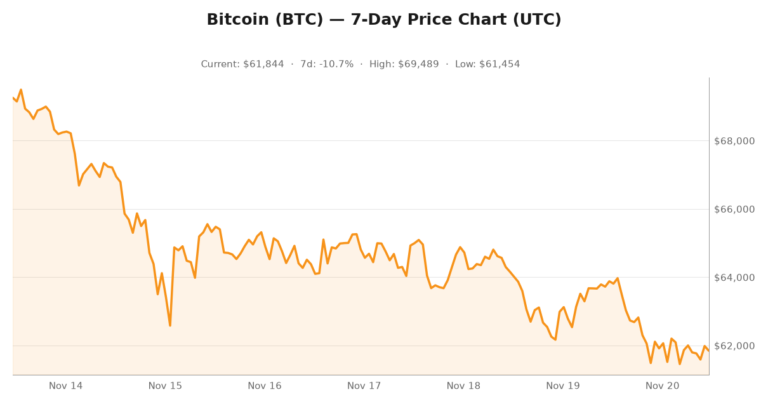
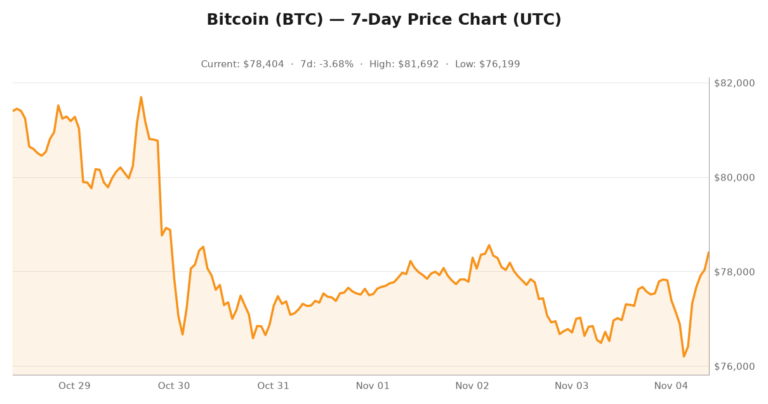
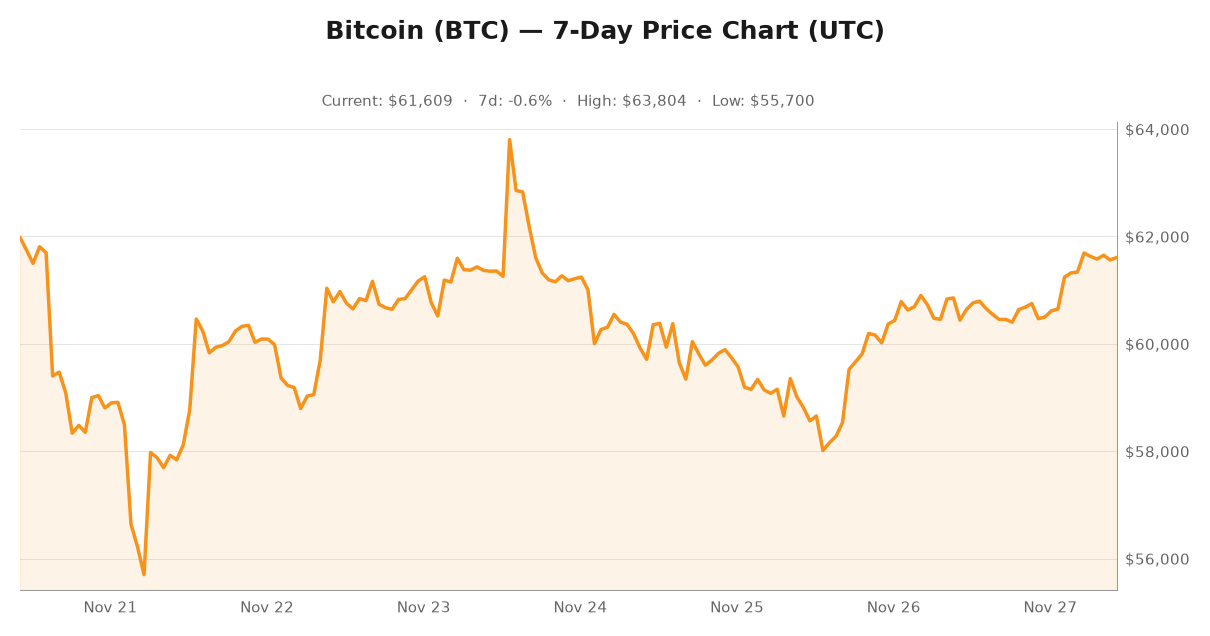
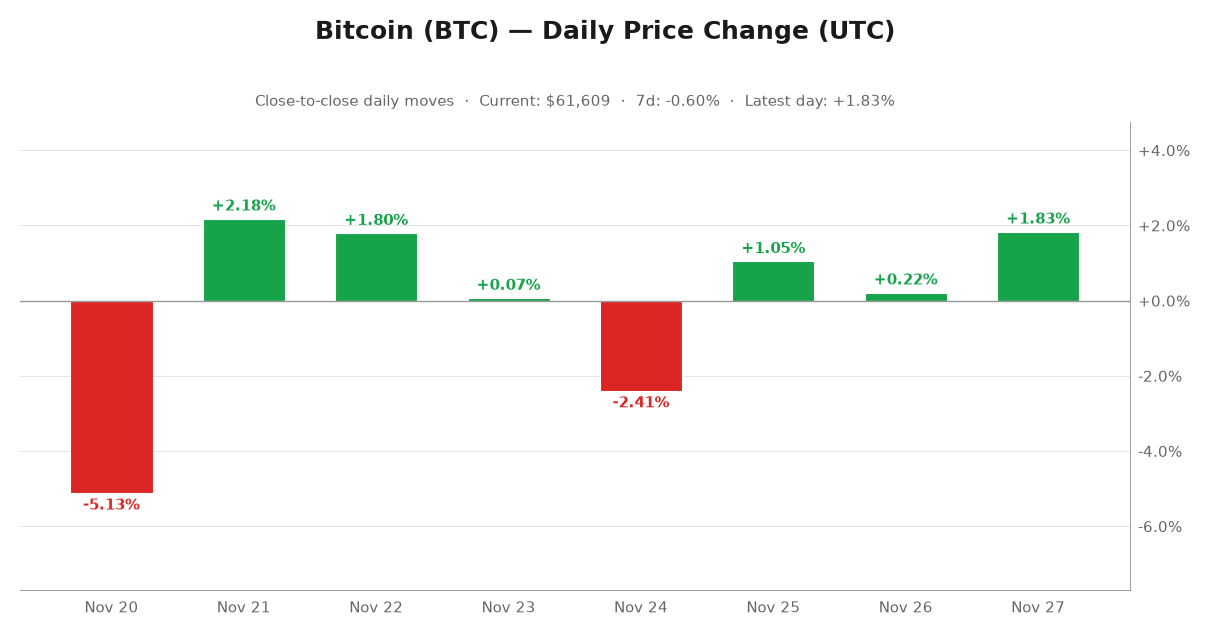
Bitcoin has been grinding lower for a year. The coin sits near $61,600, roughly 32.5% below where it traded in late November 2025, and the mood across crypto is one of patient boredom. That is the part of the story almost everyone is watching.
The part they are not watching is what happened to the businesses that secure the chain. Bitcoin mining stocks have been annihilated, with several names down 70% to 80% over twelve months, and the on-chain evidence now confirms what those equities were pricing in months ago. Bitcoin’s hash rate has rolled over. It sits about 17% below the peak it printed on November 30, 2025, the highest reading in the past twelve months.
That matters more than the equity carnage, because hash rate is the closest thing this network has to a physical footprint. When it rolls over, it is telling you that the security budget no longer covers the cost of defending the network. Here is what the data actually says.
Bitcoin’s hash rate peaked a year ago and never came back
Hash rate is the total computing power securing Bitcoin, measured in exahashes per second, or EH/s. You can track it live at mempool.space or through the Blockchain.com explorer charts, and it is the single most useful health metric for the mining economy. The monthly averages tell the story:
- November 2025: 1,108 EH/s, with a single-day peak of 1,239 EH/s on November 30
- January 2026: 981 EH/s, after a January 24 trough of 690 EH/s
- April 2026: 958 EH/s
- July 2026: 900 EH/s
- October 2026: 1,028 EH/s, a brief recovery
- November 2026, month to date: 995 EH/s
The current seven-day average sits near 1,028 EH/s. So Bitcoin’s hash rate is running roughly 17% below its 12-month high, and the November monthly average is about 10% lower than the same month last year.
Be precise about what this is and is not. It is not a collapse. The January 2026 trough of 690 EH/s is the comparison that makes today’s level look healthy, and hash rate remains far above where it sat two years ago. What is happening is a sustained downtrend away from a high, in a market where the marginal operator can no longer cover power costs at current prices.
The forward confirmation is already queued. Bitcoin’s difficulty adjusts every 2,016 blocks, and the next retarget, projected for around December 12, 2026, is expected to cut difficulty by roughly 5.5% from its current level near 145 trillion. A difficulty cut is the mechanical consequence of hash rate leaving. It is also the network formally admitting that the computing power which was here in October is gone.
Why the difficulty cut cuts both ways
Read correctly, a falling difficulty is a rescue for whoever is still mining. Fewer competitors chasing the same 450 BTC means each surviving rig captures more of the reward, and miner margins recover without a single extra watt being switched on. That is the bull case, and it is legitimate.
Read correctly again, it is also a confession. Difficulty does not fall because economics improved. It falls because capacity shut down. And the adjustment can only restore per-hash economics, not the size of the budget itself. The system redistributes a shrinking pie and calls it stability.
The revenue math is worse than the hash rate math
Hash rate tells you how much computing power exists. It does not tell you whether that power is profitable. For that you need revenue per unit of hash, and that line has deteriorated faster than the hash rate itself.
Bitcoin’s block subsidy is 3 BTC and blocks arrive every ten minutes, so the network issues 450 BTC per day to miners before fees. At today’s price near $61,600, that is roughly $27.7 million a day of guaranteed revenue. Spread across the current 1,028 EH/s, that works out to about $27,000 per EH/s per day.
A year ago, on the same 30-day-average basis, hash rate was around 1,060 EH/s and Bitcoin traded near $91,300. The same 450 BTC was worth about $41 million a day, or roughly $38,700 per EH/s per day.
That is a 30% cut in mining revenue per unit of hash power in twelve months, and that calculation ignores transaction fees entirely. A 30% margin compression on a business with brutal fixed costs, think power contracts, ASIC depreciation, land and payroll, is not a margin compression. It is a solvency event for the weakest operators, and it is the mechanism pushing hash rate down in the first place.
The compounding is the point. Price fell 32.5%, while the hash rate that has to be paid for fell only a few percent year over year. Multiply the two and you get a revenue-per-hash line that has been cut by nearly a third in a year. The Bitcoin price headline only tells you about the first factor.
The AI pivot was the exit, not the destination
From 2024 onward, the sector’s story was that miners would convert megawatts into AI data center contracts: higher margins, longer terms, less dependence on the coin. Equity investors paid a premium for that pivot. Here is what the premium is worth after twelve months of trading:
- Bitdeer (BTDR): -75.9%
- IREN (IREN): -73.5%
- Cipher Mining (CIFR): -71.2%
- CleanSpark (CLSK): -61.5%
- Galaxy Digital (GLXY): -55.9%
- MARA Holdings (MARA): -51.2%
- TeraWulf (WULF): -32.4%
- Bitcoin itself: -32.5%
Every one of those names underperformed the coin it mines, most of them by 20 to 45 percentage points, which tells you something important about how the market is pricing operating leverage. A miner is not a cheap way to hold Bitcoin. It is a leveraged, reflexive position in Bitcoin that gets re-marked daily against power contracts bought years earlier.
Two names bucked the trend: Riot Platforms (RIOT) is up 11.3% over twelve months and Hut 8 (HUT) is up 15.2%. Both had the least balance sheet strain going into the AI conversion bets, and both sold off hard over the past three months. That pattern is the tell. The market did not punish mining. It punished leverage layered on top of mining at the top of a cycle.
For holders, the corollary matters. The AI pivot was supposed to be optionality for miners, but it was also the reason they carried so much debt and so much capex. Leverage plus a 30% margin squeeze is exactly how a downcycle becomes a capitulation.
What a mining capitulation means for Bitcoin holders
- Near-term security is not the issue. At 1,028 EH/s, Bitcoin’s hash rate is still roughly 50% above the January 2026 trough and far above its level two years ago. Nobody should be running a 51% attack or a chain-reorganization story off a difficulty cut.
- Forced selling is real spot supply. Miners pay power bills in dollars and payroll in dollars, so a compressed margin gets funded by selling bitcoin. Capitulation means supply arriving into a market that has to absorb it, and that pressure shows up in spot before it shows up in headlines.
- The real risk is the hash that never comes back. If machines get leased to AI and high-performance computing on multi-year contracts, that hash is gone for good and Bitcoin’s security budget permanently resets lower. This is the scenario nobody is pricing, and it is the one that should worry long-term holders more than a 5.5% difficulty adjustment.
- Options are not pricing any of this. Deribit’s DVOL index sits near 49, which is roughly the 80th percentile of the past year, while 30-day realized volatility is 48.5% against a 90-day reading of 40.3%. The options market is pricing a nervous tape, not a mining event. That gap is where the next repricing will show up.
Three numbers to watch from here
- Hash rate. A sustained break below 950 EH/s turns a downtrend into something more serious. Track the seven-day average, not the daily prints, because day-to-day noise on this chart runs from about 800 EH/s to more than 1,150 EH/s.
- The December 12 difficulty adjustment. If the projected 5.5% cut comes in worse, the downtrend is accelerating. If it lands smaller or flat, hash rate has found a floor and the capitulation is over.
- The issuance spread. 450 BTC, about $27.7 million a day, divided across the hash rate is the actual security budget. It is roughly 30% thinner per unit of hash than a year ago, and no difficulty adjustment can fix a thin budget. It can only redistribute it.
The bottom line
Bitcoin’s price weakness is the known risk. The less-known one is that the machines securing the network are being valued like a broken business, and they are. A 30% cut in revenue per unit of hash, a 17% drawdown in hash rate from its peak, and a 5.5% difficulty cut already queued for December is what the early stages of a mining capitulation look like before anyone uses the word.
None of this is a call to sell the coin. It is a call to watch the machines. Bitcoin’s price can stay flat for years and still be fine. A shrinking security budget is a slow, grinding tax on the asset that nobody notices until it is obvious. Watch the seven-day hash rate average. If it stops falling, this was noise. If it does not, the miners were right about their costs, and the market will finally learn what the security budget is worth.