There is one number crypto traders watch more closely than the price itself: the funding rate. Right now it says Bitcoin’s derivatives market has gone quiet. Funding on the largest perpetual Bitcoin swap printed 0.00361% for the last eight-hour window, which annualizes to roughly 3.96%. The 13-week Treasury bill was yielding 4.15% on Friday. Running a leveraged long in Bitcoin no longer pays you more than the risk-free rate. That is neither a bullish backdrop nor a bearish one. It is a market that has stopped taking sides.
Here is the part that contradicts the usual narrative. While Bitcoin funding has drifted toward zero, implied volatility has surged. Deribit’s DVOL index closed at 52.8 on November 28, the 88th percentile of the past year and far above the 90-day low of 33.6. Options traders are paying up for protection while perpetual traders pay almost nothing to carry risk. Those two facts sit side by side in the data, and almost nobody is reconciling them.
What Bitcoin’s funding rate actually measures
Perpetual futures never expire, so the contract price has to be pulled back toward the spot index or traders simply trade the spread. That pull is the funding payment, charged every eight hours and calculated from the gap between the swap price and the index price. When the swap trades above spot, longs pay shorts, and the rate goes positive.
The exchange mechanics matter because this is not a fee market in the traditional sense. OKX documents the formula as a time-weighted average of the premium index plus a clamp, and Deribit publishes its own equivalent. Read funding as a positioning gauge rather than a direction call.
- Positive funding means longs are crowded and paying to hold. It is fuel for a short squeeze only when it stays extreme.
- Near-zero funding means both sides are roughly balanced and nobody is paying up for leverage.
- Negative funding means shorts are crowded and paying to hold a losing position.
Annualize any eight-hour print by multiplying by three payments a day and 365 days. That single step changes how you read almost every funding headline, because a 0.00361% print sounds trivial and a 3.96% annualized carry sounds like a real return. Both are the same number.
The leverage premium has evaporated
Here is the data as of November 28, 2026. Funding on the OKX Bitcoin perpetual averaged 4.96% annualized over the last 30 days, and the most recent print sits at the 36th percentile of the past month. Of the last 90 eight-hour windows, 40% priced below the 4.15% yield on the 13-week bill and 21% went outright negative.
Deribit tells the same story with a different accent. Its estimated Bitcoin perpetual funding rate is effectively zero right now, the 12th percentile of the past month, with 12% of hourly prints negative and a 30-day median of 0.94% annualized. Compare that with the 8.13% reading that sits at the 90th percentile of the same window.
The market is telling you the most boring thing about crypto derivatives right now: there is almost no leverage premium left. When a Bitcoin perp pays less than a Treasury bill, holding leveraged exposure is a worse trade than parking cash, and rational capital says so. The mechanical consequence is that the leverage complex has been quietly draining rather than crowding.
Why funding is pinned near the cash yield
Here is the part most commentary misses. Funding above the risk-free rate is not free money for long holders, because market makers can harvest it. The trade is simple: buy Bitcoin in the spot market, short the perpetual, collect the funding, and pocket the spread. That cash-and-carry arbitrage pushes funding down whenever it climbs far enough above the cost of capital to cover fees and margin.
The result is a structural ceiling. Once annualized funding falls to roughly the yield on short-dated Treasuries, the arbitrage stops clearing and funding settles near the floor. Every major venue also clamps the rate inside a band, which is why extremes resolve instead of persisting. That makes today’s 3.96% print, sitting just under the 4.15% Treasury yield, not a capitulation signal at all. It is where an arbitraged market is supposed to rest.
The interesting question is therefore not whether funding is low. It is what moves the anchor. The Fed’s policy rate sets the yield on short-dated Treasuries, and that yield is the opportunity cost of the spot leg in every carry trade. Cut rates and the floor under funding drops with them: the arbitrage keeps clearing at lower funding levels, the perp becomes cheaper to hold long, and leveraged demand can rebuild. Leave rates where they are and funding stays pinned near 4%, which means Bitcoin keeps trading on spot flows alone, with no leverage bid underneath it. Watch the 3-month bill for the trigger, not the funding ticker.
Price action: a 52% drawdown with no margin-call flush
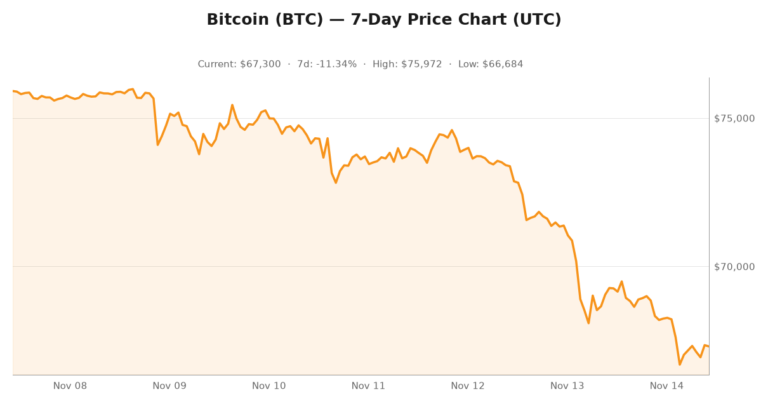
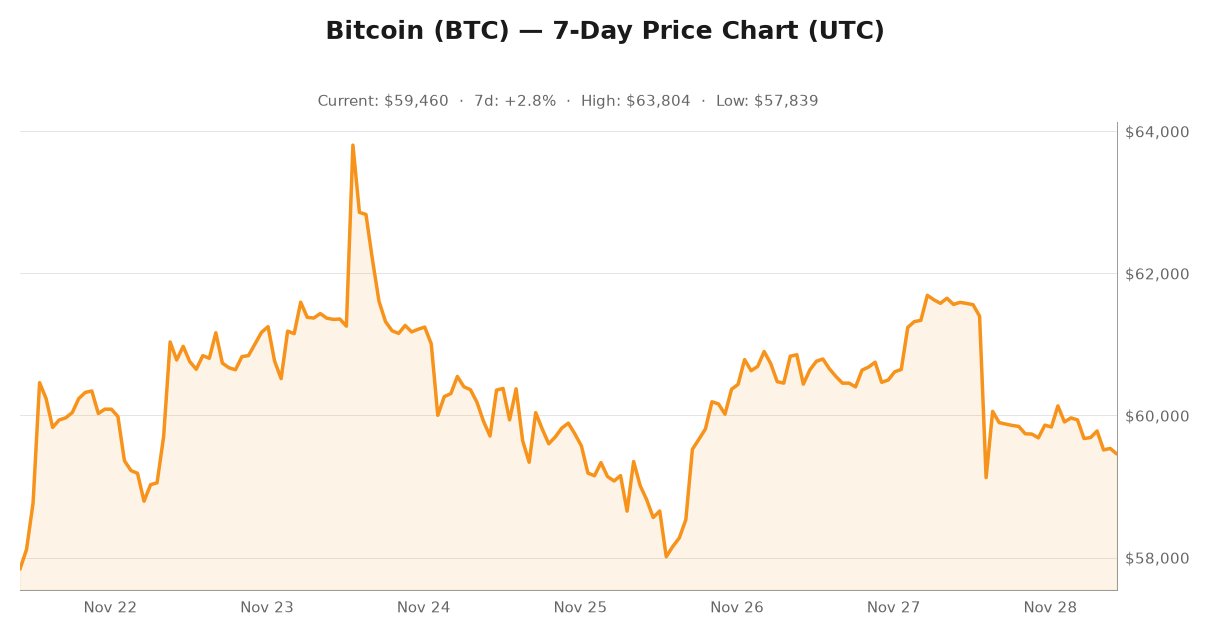
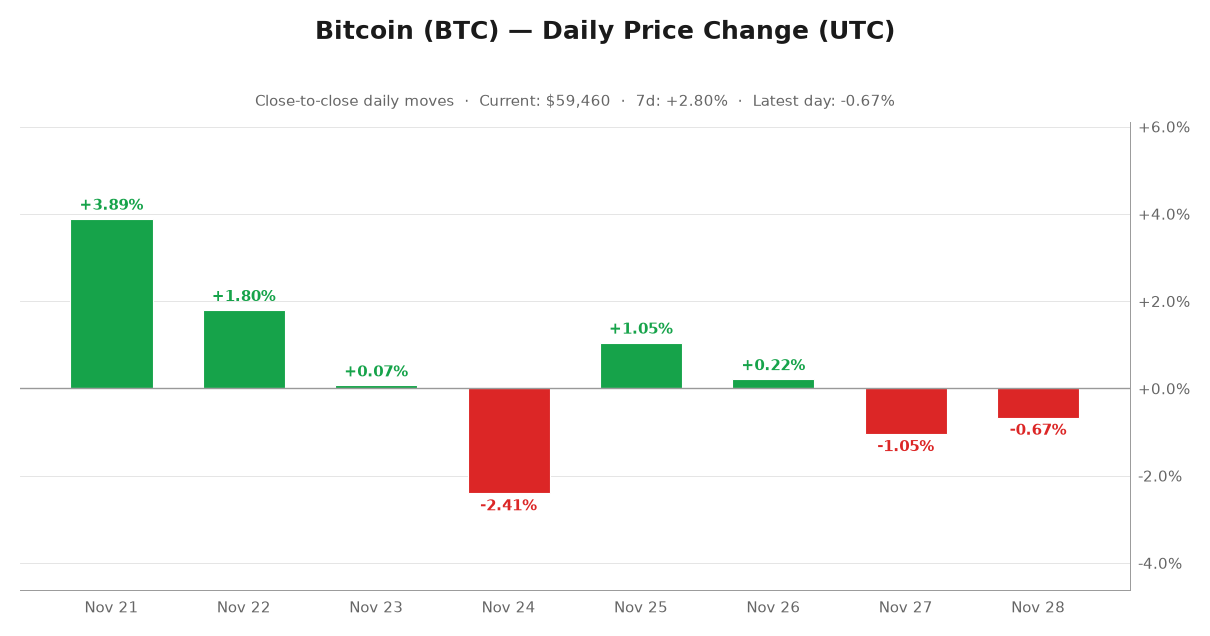
Bitcoin trades around $59,504, down 3.35% over the past 24 hours, according to CoinGecko. Total crypto market cap sits at $2.07 trillion after a 5.64% daily drop, with Bitcoin dominance at 57.76% and Ethereum near $1,651. On a 30-day view, Bitcoin is down 26.4%, even though the last seven days have gained 1.8%. It remains roughly 52% below the $124,766 closing high it set on October 6, 2025, and the 50-day average of $74,246 and 200-day average of $71,811 both sit far overhead.
Here is the detail that matters for positioning. Open interest across Bitcoin perpetual contracts on OKX has fallen from $3.47 billion on October 28 to $2.82 billion on November 27, a decline of 18.7% over a month in which the underlying lost more than a quarter of its value. Price fell and leverage fell together. That is the signature of a spot-led derating, not a cascade of forced liquidations.
The same pattern shows up in volatility. Realized volatility over the past 30 days runs at 47%, above the 40% of the 90-day window and well below the 57% of the past year. Bitcoin is not in a panic regime. It is in a slow, persistent grind, and that grind has not required a single mass liquidation.
So why are options pricing a storm?
DVOL finished at 52.8, an 88th-percentile reading for the past year, against a 30-day low of 38.1 and a 90-day low of 33.6, with the one-year high at 82.6. Deribit’s listed Bitcoin options carry roughly $20.5 billion in open interest across 952 strike listings, yet 24-hour options volume was a thin $19.4 million.
Three things explain that split. First, the DVOL move is partly mechanical: realized volatility ran at 47% while implied volatility was priced in the high 30s, so options had to reprice to catch up. Second, the buyers are hedging, not betting. Spot holders who will not sell in a 52% drawdown but want protection into year-end are buying puts, which pushes implied volatility up without creating directional conviction. Third, the thin volume confirms defensive hedging in a calm tape rather than a positioning scramble.
The result is a market paying 52.8 for protection while earning roughly nothing for leverage. Implied volatility is now richer than realized volatility. You are being asked to overpay for insurance in a market that has not delivered a genuine liquidation event in a month.
The contrarian read: forget the squeeze
Most Bitcoin commentary this month has been hunting for a short squeeze. The funding data does not support it. A squeeze needs one side stacked and paying. Funding near zero says neither side is stacked, and open interest down 18.7% says the positions themselves are smaller. There is no fuel on either side.
That reframes the risk. If the leverage complex is already small, a further decline is far less likely to become a cascade, which is genuinely good news for anyone short volatility. But it also means there is no leveraged bid sitting under the market to absorb spot supply, so grind lower becomes the default path. Low funding is not bullish. It is the symptom of absent demand for leverage, and absent demand is not the same thing as capitulation.
What would change the read
- Funding above 8% annualized for three straight days, open interest rising, DVOL falling. That is leverage returning with conviction, and it is the only version of bullish this data supports.
- Funding negative for five or more consecutive windows while Bitcoin reclaims the 200-day average near $71,811. That is shorts paying to stay short into strength, and it is a genuine squeeze setup.
- Funding near zero, open interest still bleeding, DVOL above 50. That is today’s regime: chop and slow bleed, where leverage offers no edge in either direction.
- DVOL back under 40 with funding under 4%. Volatility sellers regain control and range trades work again.
How to trade a market with no leverage premium
- Do not short low funding. A crowded short is exactly what low funding does not describe right now, and the 52% drawdown has already delivered most of the downside repricing.
- Do not chase longs into it either. With no funding tailwind and price below both moving averages, rallies will meet spot supply.
- Size for 47% realized volatility. Leveraged positions sized for a quiet market will not survive a move that large, whatever funding says.
- Prefer defined risk. With DVOL at the 88th percentile, long options are expensive. If you want exposure, consider selling premium or using small, hard-stopped spot positions instead.
- Use funding as a positioning gauge, never a direction signal. It tells you where leverage sits, and leverage tells you where the next squeeze comes from.
The cleanest summary is this: Bitcoin’s derivatives market is unleveraged and defensive at the same time. Options traders are hedging a slow bleed, perpetual traders are earning roughly cash yields to hold risk, and open interest has shrunk faster than price. The 3-month Treasury yield describes Bitcoin’s carry better than any crypto-native gauge right now. Watch funding for the regime change, not for the direction of the next candle.