There is a number buried in Bitcoin’s mining economics that almost nobody tracks, and it says Bitcoin mining in 2028 faces a test the last cycle never had. The number is the fee market’s share of miner revenue. Right now it is roughly three-quarters of one percent. In April 2024, on the largest fee day in Bitcoin’s history, fees were nearly three times the entire block subsidy.
That distinction matters because the block subsidy is the only part of miner revenue that is guaranteed, and the subsidy halves in 2028. If fees are doing nothing, the halving passes straight through to price. If fees were doing real work, a competitive blockspace market absorbs much of the shock instead. Bitcoin mining economics in 2026 have quietly removed the second option.
Bitcoin mining and the missing fee cushion
Look at what fees actually did the last time the subsidy was cut. On April 20, 2024, eight days after the 2024 halving, Bitcoin miners collected $81,050,337 in transaction fees in a single day. The block subsidy that same day was worth roughly $28.7 million at the prevailing price. Fees were 2.82 times the subsidy. That was the peak of the inscriptions cycle, and it was the closest Bitcoin mining has come to a business whose revenue does not depend on the protocol printing coins.
Across 2024 as a whole, daily fee revenue averaged $2,542,822, according to the Blockchain.com transaction fee series. For 2026 to date that same series averages $218,738 a day, about 8.6 percent of the 2024 average. Fee revenue is running at a fraction of its old level, and that is not a dip. It is a new floor for Bitcoin mining.
Now look at the most recent completed day, November 18. Fee revenue was $292,474. Total miner revenue that day was $38,014,502. Fees were 0.77 percent of the take.
- November 11: fees were 0.73% of miner revenue
- November 13: 1.02%, the high of the past week
- November 15: 0.39%, the low
- November 18: 0.77%
Mempool.space’s per-block fee data tells the same story from the other direction. Over the trailing 24 hours the average block carried 2,536,935 satoshis of fees, roughly 0.0254 BTC, against a subsidy of 3.125 BTC. Fees are running at 0.81 percent of the subsidy. The hourly recommended fee on mempool.space prices at 1 satoshi per virtual byte, the fastest confirmation is quoted at 4 sat/vB, and the whole mempool sits at about 30 megabytes.
Divide those fees across the day’s transactions and the average user paid well under a dollar to move money on the chain. On November 18, $292,474 of fees covered 674,354 confirmed transactions, about $0.43 each. That is the point where a fee market stops being a market and starts being an accounting formality, and it leaves Bitcoin mining with no second revenue stream to fall back on.
Halving math: what 2024 had that 2028 will not
The next halving lands at block 1,050,000. From the current height of 976,719 that is 73,281 blocks away, roughly 509 days, which puts it in April 2028. On that block the subsidy drops from 3.125 BTC to 1.5625 BTC, and daily issuance falls from 450 BTC to 225 BTC. At today’s price that is the difference between about $27.8 million and $13.9 million of guaranteed daily revenue for the sector. Bitcoin mining has to absorb that against a revenue base that is more than 99 percent issuance.
Compare the two halvings directly.
- April 2024: fees were running at a record pace, $81 million on the single best day, so Bitcoin mining had a genuine competitive market for blockspace. A 50 percent subsidy cut met a market that could plausibly fill part of the gap, and mining margins absorbed it while the sector kept hashing.
- April 2028: with fees near 0.8 percent of revenue there is no competitive market to fill the gap. The subsidy cut becomes a straight 50 percent revenue cut, and price becomes the only variable left to adjust.
That reframes what a halving even is. A halving is normally modeled as a miner stress test: can hash rate shut down fast enough to defend margins? With fees this small the stress test is not about miners. It is a test of whether spot demand can absorb 225 fewer BTC per day without a blockspace bid to smooth the transition.
Price action: a 10% slide with no capitulation
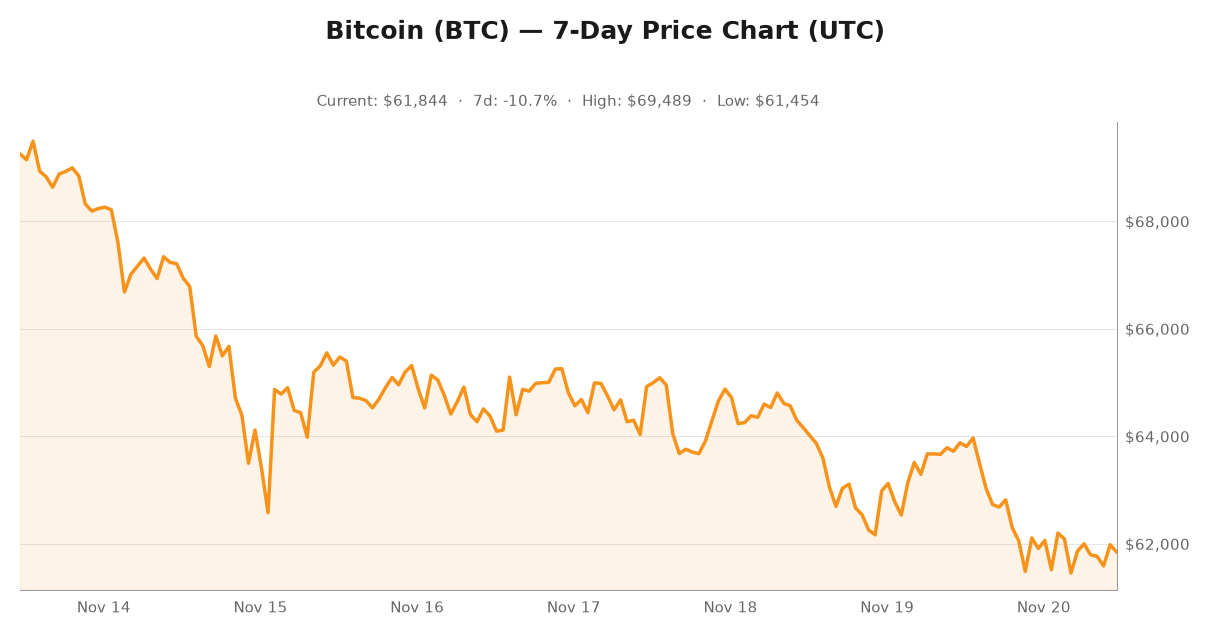
Bitcoin is down about 10.5 percent over the past week, from roughly $69,300 to about $62,000, with the market cap near $1.24 trillion per CoinGecko. The ETF flow tape is worse. US spot Bitcoin ETFs posted net outflows on eight of the last nine sessions, according to Farside’s flow data: $582.3 million of redemptions on November 19 alone, the largest session of that run, and roughly $2.19 billion cumulatively across the nine sessions.
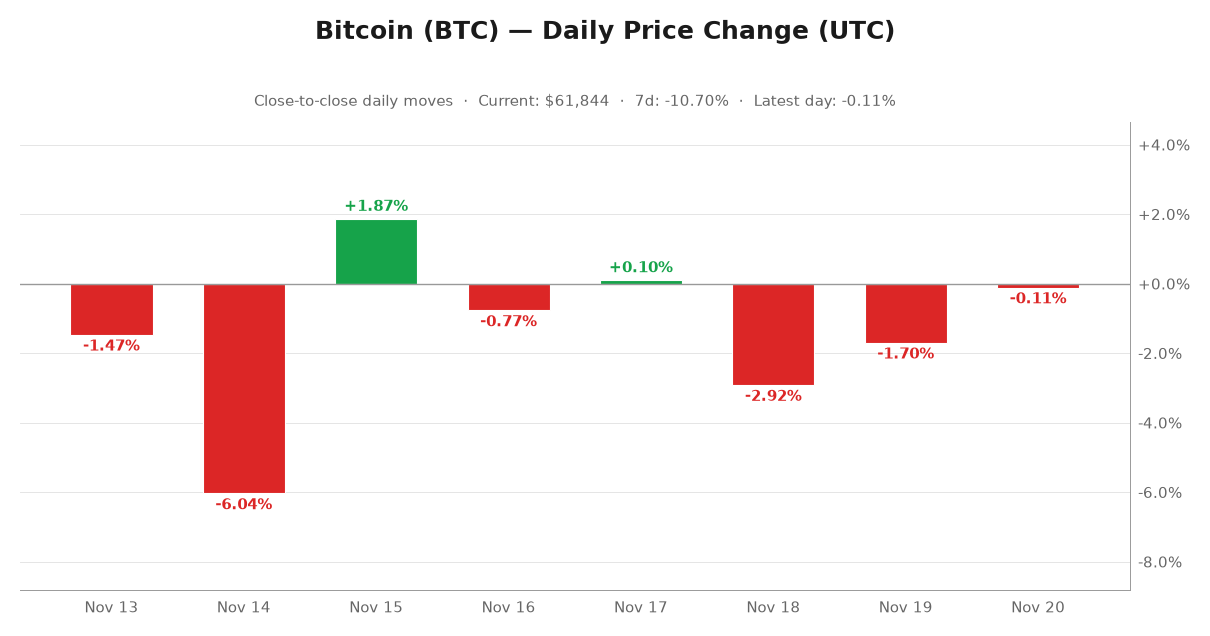
That is what a drawdown looks like when the marginal buyer steps away. Which is why the next line of data matters more than any of it. The network did not flinch.
Average hash rate over the past month has run between 0.81 and 1.15 zettahash per second, and the current estimate is about 1.04 ZH/s. For context, the one-year range on mempool.space’s hash rate chart runs from 0.71 ZH/s at the low to 1.24 ZH/s at the high. Hash rate is near the top of its annual range, not the bottom.
Difficulty tells the same story with a lag. The November 12 retarget cut difficulty 9.13 percent, from 148.36 trillion to 134.82 trillion. Bitcoin mining capitulated, briefly, and then it came straight back. The next retarget at block 977,760 is projected to raise difficulty 9.16 percent, with 1,041 blocks left to go and an estimated date around November 26. The difficulty adjustment projection is 48 percent complete, and it points up.
So: price down 10 percent, ETF redemptions running near $600 million a day, hash rate near annual highs, and difficulty about to rise 9 percent. Whatever Bitcoin mining capitulated in November, it was not a sustained retreat from the sector.
The squeeze is coming from both sides at once
There is a second-order problem hiding in the same numbers. Difficulty is about to rise 9.16 percent while price has fallen 10.5 percent in a week. Bitcoin mining revenue per unit of hash rate is compressing on both sides simultaneously: the numerator falls with price, the denominator rises with difficulty. When fee revenue is 0.8 percent of the total, there is no third term left to absorb that squeeze.
For mining firms, that means the hashprice conversation is now the whole conversation, and Bitcoin mining has no fee market left to argue with. It is a narrower and more fragile way to run a business than the one Bitcoin mining had in 2024, when a fee market was there to catch the downside. For holders, it means the halving narrative has quietly changed shape. It is no longer primarily a story about miner capitulation and a bottom. It is a story about who bids for 225 fewer coins a day.
What would actually change the math
- A sustained fee market above 1 sat/vB. The threshold is structural, not a round number. If fees ever cover even 5 percent of miner revenue again, the 2028 halving becomes a margin negotiation instead of a price event. Nothing in the current tape points in that direction.
- The November 26 retarget. A smaller than projected increase means hash rate is finally rolling over. A confirmed 9 percent increase means Bitcoin mining is re-levering into the drawdown.
- ETF flows turning. Eight negative sessions out of nine is a bid problem, not a sentiment problem. When that flips, price stops being the only variable in the equation.
- Hash rate breaking below 1.0 ZH/s. That would be the first genuine capitulation print of this cycle. It has not happened.
One more input for the ledger: 20,114,465 BTC are in circulation right now. The 2028 halving removes half of the new supply at exactly the moment Bitcoin mining has no fee revenue to cushion the shock. Whether that matters depends on who is buying, and on the evidence of the last nine sessions the ETF channel has been a seller.
We covered the hashprice side of this in our Bitcoin Mining Is Squeezed piece, and the broader fee market picture in our Bitcoin Mining archive. The part that has not been priced is the subsidy dependency itself.
Bottom line
The market’s framing of this cycle is that ETF buyers set the price and miners set the floor. That framing is backwards right now. The ETF channel is net selling, the miner channel is not capitulating, and the fee market, the third leg that used to balance the two, has shrunk to three-quarters of one percent of miner revenue.
That is not automatically bearish. A network whose security is funded entirely by planned issuance is a network with a hard, credibly enforced monetary policy. It is also a network where every future stress event has exactly one dial, and that dial is price. Bitcoin mining has become a pure bet on which way it turns. April 2028 is when the dial gets turned. Bitcoin mining heads into it with near record hash rate, rising difficulty and a fee market that has already demonstrated it will not show up. The halving that was supposed to be a mining problem is now, by arithmetic, a demand problem.
Watch the retarget on November 26 and the ETF tape in the meantime. One of those two breaks first, and it tells you which problem 2028 actually is.