Bitcoin’s Hash Rate Didn’t Break. The AI Story Is Wrong.
There is a story going around that Bitcoin’s mining industry is being hollowed out by artificial intelligence, and that the network’s security is about to pay the price. It shows up in earnings coverage, in social threads, and in the price action of miner-linked equities. It is also, on the chain data, mostly wrong, and the reason it is wrong turns out to be more interesting than the story it replaces.
Bitcoin’s estimated hash rate on October 30 was roughly 964 exahashes per second, according to the live estimator at mempool.space. That figure is about 3.8 percent higher than the 928.6 EH/s reading on October 1, and it sits almost exactly on the three-month average of 958.9 EH/s. If miners were abandoning the industry in bulk, that is not the fingerprint you would expect to see.
What Actually Happened to Bitcoin’s Hash Rate
The print that produced the panic was October 24: an estimated 1,228.4 EH/s, the highest reading in the sample and well outside the range the network had been running. Six days later the estimate was back to 964.3 EH/s. That is a 21.5 percent normalization, and it is the single most important thing to understand about the past week in Bitcoin.
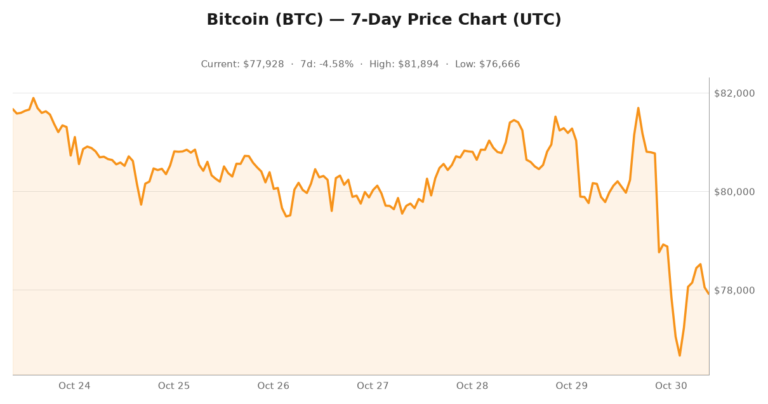
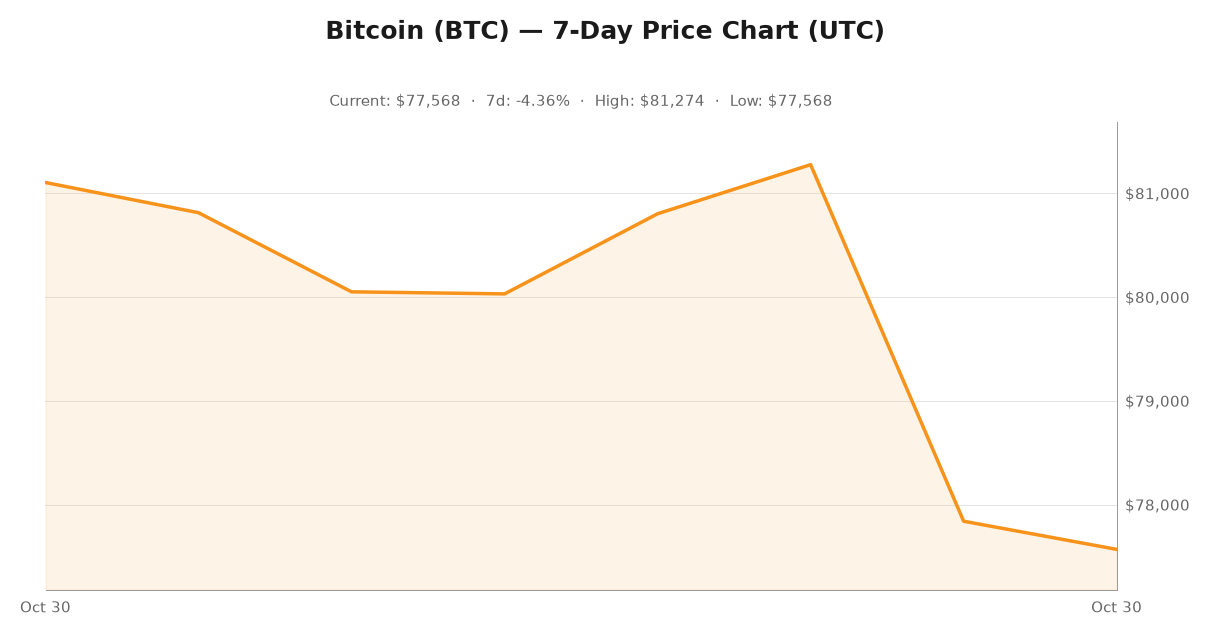
Two caveats deserve equal billing with the number itself. First, daily hash rate is an estimate, not a meter reading. It is derived from observed block intervals and carries meaningful noise, so any single-day print deserves roughly a 5 to 10 percent error bar. Second, the decline was concentrated in the final days of the month, which is exactly the fingerprint a price shock produces. Bitcoin traded near $81,274 on October 29 and sits around $77,568 at the time of writing, down roughly 3.2 percent over 24 hours and 4.4 percent on the week, with 24-hour volume near $75.7 billion, roughly triple the pace of the prior week.
- October 1: 928.6 EH/s
- October 24 peak: 1,228.4 EH/s
- October 29: 1,010.9 EH/s
- October 30: 964.3 EH/s
- Three-month average: 958.9 EH/s
So the honest description is not that miners are leaving Bitcoin. It is that a six-day burst of capacity came online, then went back to normal. Those are very different diagnoses, and only one of them implies a structural problem for the network.
The November 13 Difficulty Print Is the Real Story
Bitcoin reprices its own difficulty every 2,016 blocks, and the next adjustment lands at height 975,744, about 1,941 blocks away, arriving around November 13. Current estimates put the change at -4.10 percent, and that would follow a +5.54 percent increase on October 29. The network is formally preparing to lower the price it charges for hash, six days after raising it.
This is the mechanism doing exactly what it was designed to do. Hash is repriced to clear the market between what miners are willing to sell and what the network is worth. A negative print after a positive one is the chain’s own verdict that some of the recent hash was temporary. It is also the most honest signal available, because it is a consensus rule rather than a headline, and it lands on a fixed date.
Why Difficulty Matters More Than Any Hash Rate Headline
Hash rate is a lagging, noisy estimate of a willingness to sell. Difficulty is the network’s clearing price, printed on schedule, with no narrative attached to it. When miners with negative margins power down, hash rate drops first and difficulty follows roughly two weeks later. For that reason, November 13 is the date worth circling on a Bitcoin calendar, and every daily hash rate print in the meantime is noise around it.
The AI Pivot Is Downstream, Not Upstream
This is where the narrative gets the causality backwards. Public companies that also operate mining fleets, including Core Scientific, TeraWulf, IREN, Riot Platforms and Cipher Mining, have all announced AI or high-performance-computing hosting arrangements since 2024. Coverage usually treats this as miners defecting to a new industry.
It is closer to the reverse. A signed AI hosting contract is a multi-year, fixed-price revenue stream. Bitcoin mining is a spot-market business that earns whatever the network pays that day. The data center contracts are financed with mining cash flow and mining hardware. Bitcoin mining is therefore not competing with the AI buildout for the same miners. It is funding it.
That is precisely why a price drawdown is uncomfortable on both sides at once. When Bitcoin fell more than $3,500 this week, mining revenue compressed immediately, while the data center capital schedule did not shrink by a dollar. Same squeeze, both businesses. A miner who tells you an AI deal de-risks the company is not lying about the deal. They are describing a second mortgage on the mining business, not a substitute for it.
The Security Budget, With Real Numbers
Bitcoin’s block subsidy is 3.125 BTC. At $77,568, that is about $242,400 of new issuance per block, or roughly $34.9 million a day across 144 blocks.
Now the fee market. The recommended fee right now is 1 to 2 satoshis per virtual byte. A full 2 MB block at 1 sat/vB clears about 0.02 BTC in fees, and at 2 sat/vB about 0.04 BTC. Against a 3.125 BTC subsidy, the entire fee market contributes somewhere between 0.6 percent and 1.3 percent of block revenue.
Run the per-machine math from there. At 964 EH/s of network hash and the current Bitcoin price, a 70 TH/s miner earns roughly $2.50 a day in gross revenue, before a single kilowatt-hour is billed. About 99 percent of what the industry collects is new issuance, while the cost side of that ledger, power, depreciation and capital for newer ASICs, is denominated in dollars that do not fall when Bitcoin does.
That is why the fee market is the most under-watched number in the entire system. It is the only mechanism that can eventually pay for security without adding new supply. If Bitcoin is going to pay its miners something other than a depreciating subsidy, it will show up first in a rising mempool, not in a miner press release.
Concentration Rises When Hash Falls
There is a second-order effect that tends to get lost. When the marginal miner powers down, the large pools grow as a share of what remains. Over the past seven days, Foundry USA found 280 blocks, AntPool 218 and F2Pool 175, or roughly 66.8 percent of the approximately 1,008 blocks mined in the week between the top three. A pullback concentrates the network even as it shrinks it, and concentration is the metric that actually matters for censorship resistance. Track it alongside Bitcoin hash rate, not after it.
What to Watch Over the Next Two Weeks
- The November 13 difficulty adjustment at height 975,744. A print worse than the -4.1 percent estimate means the hash exit is accelerating. A flat or positive print means the October 24 spike was never real capacity.
- Whether hash rate holds above roughly 950 EH/s for two consecutive weeks. That is the threshold where the three-month average stops looking like support.
- The fee market. A move from 1 sat/vB toward 5 sat/vB while hash rate declines would mean spendable capacity is returning to the mempool and the security budget is starting to diversify away from issuance.
- Hash rate and power disclosures in miner filings, rather than the headline value of AI hosting contracts. The contracts tell you where capital is going. The hashrate tells you where the hash is.
- Top-three pool share. If it pushes past 70 percent, it is a live resilience metric rather than a footnote.
The Bottom Line
Bitcoin’s hash rate did not break. It came in roughly 3.8 percent above where it started the month and right on its three-month average, after a spike nobody fully explains on October 24. Anyone using the AI narrative as evidence that Bitcoin’s security is deteriorating is reading the wrong chart.
There is a real story underneath the wrong story, though. The fee market contributes well under 1.3 percent of block revenue. A mid-sized miner clears about $2.50 a day before power. The network is about to cut difficulty for the first time in this cycle, and the pools that survive that cut will control more of Bitcoin than they did a month ago. The security budget is now almost entirely a bet on the price of a token, and that token just fell 4.4 percent in a week on triple the volume.
So watch the November 13 print, watch the fee market, and treat the AI announcements for what they are: a financing strategy for miners who are still very much in the mining business. CoinDesk’s markets desk will carry the flow data, and mempool.space will carry the chain data. On Bitcoin, the chain is where the answer is.