Bitcoin DeFi TVL Is Lying. Here’s What the Data Says.
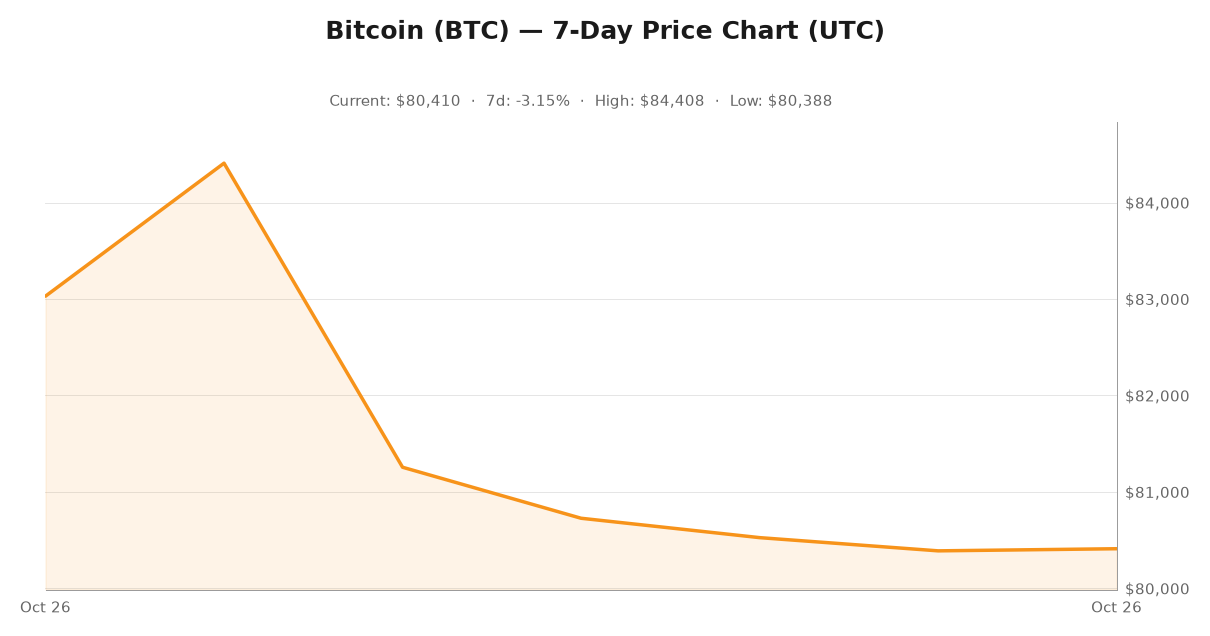
Every few months somebody posts a chart showing Bitcoin’s decentralized finance sector growing, and the numbers are hard to ignore. As of October 26, 2026, the Bitcoin chain in DefiLlama’s data holds roughly $4.27 billion in total value locked. Bitcoin trades near $80,436 per CoinGecko, down 2.8% on the week, 4.2% over 30 days, and about 36% below the October 2025 high of $126,080.
That $4.27 billion sounds like a real business. It is not $4.27 billion of DeFi. After a week pulling apart the underlying protocol-by-protocol data, the picture is stranger than the headline: one protocol accounts for 76% of it, and most of the rest is Bitcoin sitting inside a corporate wrapper rather than money moved by smart contracts.
This gets lost because “Bitcoin DeFi” sounds like a category, so we treat it like one. It is not a category. It is roughly 64 protocols of wildly different quality, and the aggregate number is a weighted average dominated by whichever one is currently paying the biggest token incentives. If you want the real state of Bitcoin DeFi, you have to decompose it. So let us decompose it.
The Headline Number Is 0.26% of the Supply
Start with the number everybody quotes, then do the division nobody does.
- Bitcoin ecosystem TVL: $4,272,246,926 (DefiLlama, October 26, 2026)
- Bitcoin price: $80,436 (CoinGecko, October 26, 2026)
- That converts to roughly 53,100 BTC of value locked
- Circulating supply: 20,103,596 BTC
- So the entire DeFi sector on Bitcoin controls about 0.26% of the money it is built on
And the trend is not a hockey stick. Bitcoin chain TVL was $6.57B in late November 2025 and $6.67B at the end of December, then fell to $4.29B by February 2026. It has since oscillated between roughly $3.9B and $5.1B for eight months. The sector is, in aggregate, smaller than it was a year ago — down about 49% from $8.35B in October 2025.
Any narrative claiming Bitcoin DeFi is exploding is describing one protocol, not a sector.
The 76% Problem: Babylon Is the Whole Sector
Here is the single most important number in this data set: Babylon Protocol holds $3.27 billion of TVL, or 76.5% of all Bitcoin-chain TVL. Strip out Babylon and the entire DeFi sector on Bitcoin is about $1.0 billion. For scale, restaking leader EigenCloud holds $5.96B on Ethereum, and the same mechanism has been eating Ethereum’s DeFi security budget for two years, so Babylon is genuinely large by restaking standards — roughly half of what EigenLayer once commanded of the Ethereum security budget.
What Babylon Actually Does
Babylon lets Bitcoin holders delegate their BTC to professional finality and security providers who stake on chains such as Cardano, Core and BitcoinOS. Delegators receive a BTC-denominated yield in exchange. It is the most successful attempt yet to make Bitcoin productive without touching consensus rules: staking runs through covenant-style spending paths and pre-signed transactions rather than a soft fork.
That is a genuinely interesting engineering result, and CoinDesk has covered the covenant mechanics in detail. It is also the entire sector by weight. The rest of Bitcoin’s restaking landscape, for comparison:
- Babylon Protocol — $3.267B (down 3.3% over seven days)
- Lombard LBTC — $597M
- GTBTC — $276M
- b14g — $257M
- SolvBTC LSTs — $78M
- Jito Restaking (Solana) — $17M
- Solayer Restaking (Solana) — $10M
Everything else in the category, including the projects that launched with the most fanfare, is rounding error against a $3.27B leader. In a sector this young, concentration is not a theoretical risk. It is the only fact that matters.
The Wrapper Problem: Most “Bitcoin DeFi” Is Not DeFi
Next, strip out the custodial wrappers. A large share of Bitcoin’s DeFi headline TVL is not Bitcoin in a contract at all — it is an IOU from a company, redeemable at that company’s discretion.
- WBTC — $9.29B
- Coinbase Bridge — $7.87B
- Binance Bitcoin — $5.44B
- Unit — $946M
- Kraken Bitcoin — $755M
- Function FBTC — $658M
- Lombard LBTC — $597M
- SolvBTC — $490M
- enzoBTC (Lorenzo) — $480M
- Nexus BTC — $359M
- tBTC — $339M
- Bedrock uniBTC — $338M
Counting Custody as Decentralization
Some of these are legitimately decentralized — tBTC, which uses threshold signing with a federated signer set, is the strongest case in the group. But many are single-custodian: one company holds the Bitcoin, mints a token, and owes you redemption. That is a brokerage product with a ticker symbol. Counting it as DeFi TVL is a category error, and it inflates the sector’s apparent health.
This is why the “Bitcoin DeFi” thesis deserves a harder look. If your argument is that Bitcoin needs a native financial layer, then custodial wrappers are evidence against that argument, not for it. A wrapper requires a trusted issuer, which means the user trusts a company — precisely the thing a smart contract is supposed to eliminate.
What the App Layer Actually Looks Like
Now the part that matters if you are bullish on Bitcoin as a settlement layer: the applications where Bitcoin is the settlement asset and contracts do the work.
- River (CDP, CeDeFi) — $79M
- THORChain DEX — $64M
- B2 Buzz bridge — $63M
- AZverse perps — $52M
- Templar lending — $30M
- Mento V2 (algo-stables) — $8.9M
- BTCFi CDP — $7.1M
- Yala — $2.3M
- Surge Credit — $1.8M
Add those up and you get a little over $300M. The genuinely contract-driven, Bitcoin-settled DeFi layer is a rounding error inside the rounding error. Perps, lending and stablecoins on Bitcoin — the three things that actually create utility demand for blockspace — remain embryonic, in a market where Bitcoin has been live for seventeen years and Lightning, the real consumer-scale solution, has been flat through most of 2026.
Compare that with the top of this article and the conclusion is uncomfortable but honest: Bitcoin’s DeFi sector is, today, a staking market with some lending attached, not a financial system.
Where the Yield Comes From, and Why It Should Worry You
Here is the part most coverage skips. When Babylon pays roughly 10% annualized on staked Bitcoin, where does that yield actually come from?
Not fees. Not borrower interest. The honest answer: token emissions from Babylon Genesis, distributed to security providers who pass a portion to delegators. That is the same reflexive subsidy structure that powered the 2023–24 restaking boom on Ethereum, and it carries the same failure mode. The subsidy is real today, and it is “self-financed” only in the sense that a token with a market price converts into somebody else’s cost.
Look at Babylon’s own chain for a tell. Its TVL is $259,957 today; a year ago it was $29,895. Chain TVL grew almost 9x in twelve months while the Bitcoin-side TVL sits at $3.27B and is falling 3.3% over the past week. Real usage of the chain hosting the restaking economics is a rounding error. The capital sits on the Bitcoin side, earning a token-funded spread, and the actual application layer is nearly empty.
That is a flywheel with the flywheel part missing. DeFi protocols funded by emissions can look identical to fee-funded protocols right up until the emissions stop, and then the whole stack reprices at once.
The Bull Case, Stated Honestly
Steelman the other side, because the contrarian read deserves a fair fight.
- Bitcoin’s settlement rails are the moat. It is the only asset with a 17-year, trillion-dollar, credibly neutral settlement record. If any crypto asset becomes the collateral layer for on-chain credit, Bitcoin is the obvious candidate — and 0.26% penetration is a very low bar to clear.
- Wrappers are onboarding rails, not the destination. Custodial wrappers get Bitcoin into wallets where users can experiment. If you hold WBTC and later discover a DeFi protocol, the capital is already there. Wrappers can be the on-ramp even when they are not the destination.
- Staking is real demand for Bitcoin’s security budget. Babylon turns idle Bitcoin into productive capital without consensus changes, which is a far more credible path than any soft-fork proposal currently on the table.
- Small base, high relative growth. A sector at $4.27B can double without anyone noticing, and 76% concentration in one well-run protocol is exactly what a market looks like when it is consolidating around a winner.
All of that is fair. The counter is equally fair: none of it changes the fact that the number being marketed is not measuring what most readers think it measures.
Five Numbers to Watch
If you trade this theme, these are the metrics that actually matter, in order of importance:
- Bitcoin chain TVL excluding Babylon. About $1.0B today. This is the honest size of the DeFi sector.
- Babylon’s share of that TVL. Above 80% and the sector is a single point of failure. Below 60% and it is genuinely diversifying.
- Contract-driven app TVL. Perps plus lending plus algo-stables. Break $500M and the thesis has evidence behind it. Still under $300M and it is a story.
- Babylon Genesis emissions and unlocks. When the subsidy funding staking rewards gets diluted, or token sell pressure hits, the yield compresses and the TVL leaves faster than it arrived.
- Bitcoin below $80,000. BTC is down 2.8% this week, 4.2% over 30 days, 28.5% year over year, and 36% off the October 2025 ATH. Staked yield in dollars falls with the asset, and capital rotates fast when the denominator shrinks.
The Bottom Line
The $4.27 billion headline is real, and it is also close to meaningless on its own. Decomposed, Bitcoin’s DeFi sector turns out to be one large restaking protocol, a shelf of mostly custodial wrappers, and a genuinely useful app layer that is still tiny. That is not a failure — it is a market in its first serious attempt at finding what Bitcoin-native finance looks like.
But do not confuse sector size with sector health. When 76% of a category sits in one protocol that pays 10% yields out of token emissions, you are looking at a reflexive subsidy, not a fee market. The infrastructure may be excellent. The economics are borrowed from the future.
Watch the five numbers above, and treat every “Bitcoin DeFi” TVL headline as a question rather than a statistic. If you want the raw series instead of someone’s summary, the DefiLlama Bitcoin chain page and the CoinGecko Bitcoin market data are where this analysis came from — and where you can check whether I was right six months from now.