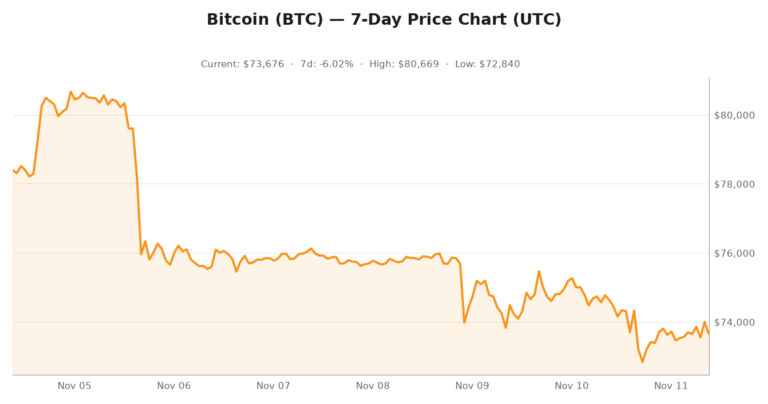
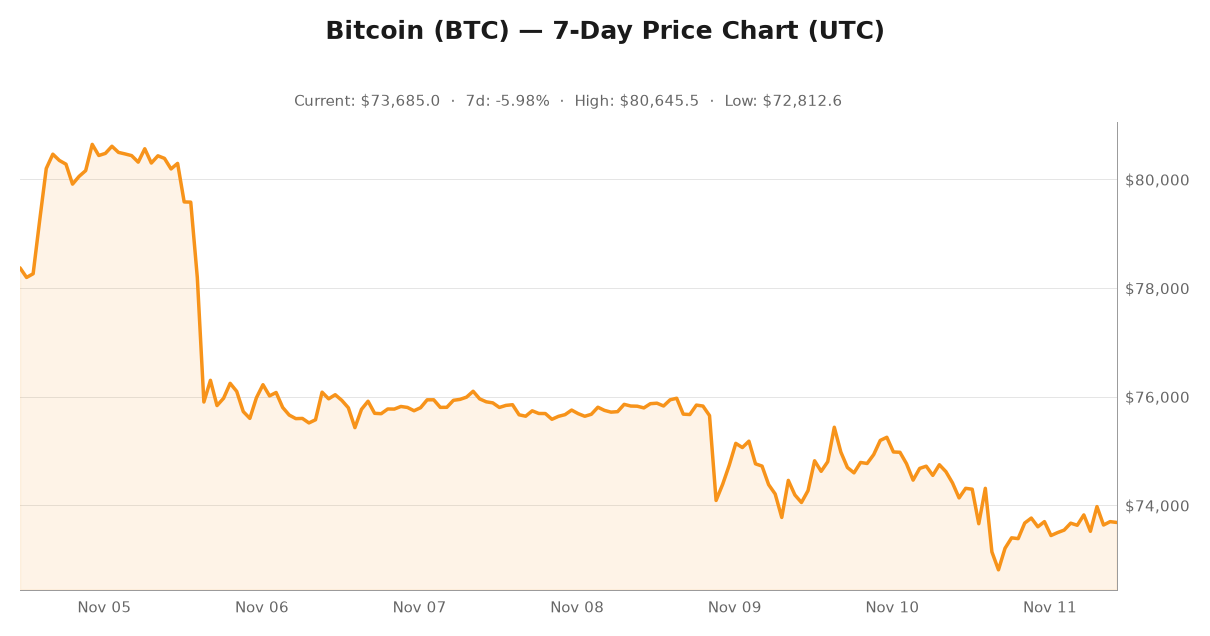
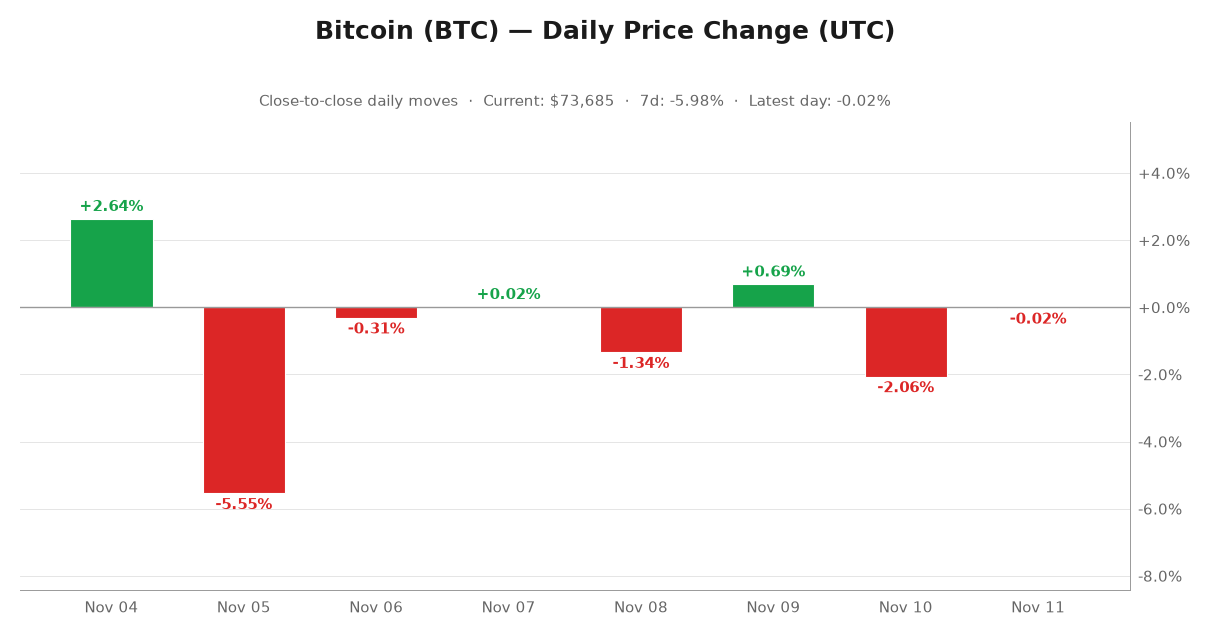
Bitcoin is trading near $73,679, down roughly 6% over the past seven days, while the total crypto market sits at $2.45 trillion after a 3.8% slide in 24 hours. That is the chart everyone is watching. But the more informative number for how Bitcoin actually works today is not on any price chart at all: Bitcoin fees have fallen to 1 satoshi per virtual byte at every tier of the mempool, the cheapest block space the network has ever offered. Read that correctly and the bearish tape starts to look a lot less informative.
This is not a piece about price. It is about Bitcoin fees, and what a 1 satoshi fee market says about where Bitcoin is heading for the rest of 2026. The numbers below are live, pulled from the mempool and on-chain data on the morning of November 11, 2026.
The Mempool Is Telling You What the Price Isn’t
As of this morning, the Bitcoin mempool held 63,994 unconfirmed transactions spanning 31.36 megabytes of virtual size, paying 3,877,598 satoshis in total fees. That works out to an average of roughly 0.124 satoshis per virtual byte across everything waiting. Every fee tier on mempool.space reads the same: fastest, 1 sat; half-hour, 1 sat; hour, 1 sat; economy, 1 sat; minimum, 1 sat. Not one tier charges a premium for urgency. There is no queue. There is no congestion.
The next block template confirms it. At roughly 997,918 virtual bytes, the pending block carries 5,870 transactions and 531,044 satoshis of fees, with a median fee of 0.127 satoshis per virtual byte. The block behind it holds 7,983 transactions for 123,013 satoshis. The fee histogram on the dashboard shows the mass of the queue, roughly 17.8 million virtual bytes, sitting in the 0.12 sat band.
Compare that with the historical norm of 2 to 20 satoshis per virtual byte during moderate demand periods. Bitcoin fees are not merely low right now. They are pinned at the network’s absolute minimum, and the reason is not a collapse in usage. It is efficiency.
What One Transaction Actually Costs Today
Here is the number that usually gets missed. A typical Bitcoin transaction occupies about 140 virtual bytes. At 0.124 satoshis per virtual byte, that is roughly 17 satoshis, or about $0.013 at current prices. A standard on-chain Bitcoin payment now costs roughly one cent.
Now pull up the metric most people assume represents cost: the cost-per-transaction series on blockchain.info, which divides miner revenue by transaction count. On November 10 it printed $55.81 per transaction. On November 9 it was $61.16. The gap between $0.013 and $55.81 is not a contradiction. It is the entire story of how Bitcoin is funded, and it is why Bitcoin fees deserve a closer look than the price chart.
Do the subsidy math. Each block pays 3.125 BTC, worth about $230,000 at today’s price. The pending block’s 531,044 satoshis of fees equal roughly $391. Bitcoin fees are therefore about 0.17% of the block reward. Clear the entire 31.36 megabyte mempool right now and the total bill would come to under $2,900. Bitcoin block space is, functionally, free.
Why Bitcoin Fees Fell: Demand Moved Up a Layer
Two forces explain the collapse. The first is batching. Bitcoin blocks now carry between roughly 2,900 and 4,800 transactions, and daily confirmed transactions have ranged from about 383,000 to 725,000 over the past two weeks. Exchanges and custodians absorb thousands of individual user transfers into a handful of consolidated on-chain transactions, so the network settles the same economic activity using a fraction of the blocks.
The second is that small-value payments stopped using the base layer at all. Lightning Network channels and other layer-2 systems absorb the coffee-and-remittance traffic that historically bid up Bitcoin fees. What remains on Bitcoin is settlement: large transfers, ETF and custody rails, tokenized assets, exchange balances. That is the part that gets lost in the noise. Low fees are not a symptom of a network being abandoned. They are the finished state of a network designed to be a settlement layer. The base layer’s job is to be boring, expensive to attack, and cheap to use for the transactions that matter.
The Fee Market and the Security Budget Are Not the Same Thing
Miners are not going hungry because Bitcoin fees are low. Daily miner revenue has held between roughly $26.5 million and $33.9 million over the last five days, and essentially all of it is subsidy. Network hash rate currently sits near 968 exahashes per second, with difficulty at about 148.36 trillion after two consecutive upward adjustments in October, roughly 5.9% and 5.5% respectively. Security is still being bought at full price.
The correct conclusion is not that Bitcoin’s economics are broken. It is that Bitcoin’s economics run on two distinct engines: a subsidy engine funding security, and a fee engine that has not yet been needed. When Bitcoin fees do arrive, they will arrive from settled value and tokenized assets rather than from small payments, which means the fee market can stay dormant through an entire drawdown without breaking the network.
The Bull Case Nobody Is Pricing
Make the contrarian argument carefully and it is a strong one. Bitcoin fees being near zero means Bitcoin is currently the cheapest large-value settlement rail among the major financial networks: cheaper than correspondent banking, cheaper than most stablecoin transfers, and cheaper than tokenizing assets on a network where you pay per transfer. For institutional infrastructure builders, that is not a bear case. It is an invitation.
The market data supports the read that Bitcoin’s role is consolidating even as its price consolidates. Bitcoin dominance sits at 60.44% of a $2.45 trillion total market, and over the last seven days Bitcoin fell from roughly $80,645 to a low near $72,812. Bitcoin fees never moved during that decline. They do not care about price, which is exactly what the fee market of a settlement layer should look like.
There is a quieter implication too. If Bitcoin fees are effectively free, the marginal cost of putting value on the Bitcoin network approaches zero, and Bitcoin becomes infrastructure instead of an investment you hold. The fee market does not need to be expensive for that shift to happen. It only needs to be predictable. Right now it is 1 satoshi, which is about as predictable as a fee market gets.
What Would Break This Thesis
Two things. The first is a demand shock: a sustained wave of inscriptions, token launches, or settlement activity that pushes Bitcoin fees back into double digits and makes block space scarce again. That would be bullish for miners and inconvenient for users, the classic trade-off, and it would prove the fee market is alive and merely dormant.
The second is a long, slow decay. If the fee engine never starts and the subsidy keeps stepping down, the security budget eventually gets thinner. That is the genuine bear case for Bitcoin’s economics, and it is not today’s fee print. It is a five-year trend of subsidy dependence with no fee market forming behind it.
Five Numbers to Watch This Week
- The fee tier panel. When the fastest fee prints above 5 satoshis per virtual byte and stays there, demand is returning to the base layer. Until then, Bitcoin fees are telling you that block space is abundant.
- Total mempool virtual size. Below 10 megabytes means a quiet chain. Sustained readings in the hundreds of megabytes mean a congested one, and Bitcoin fees will be repricing before the price notices.
- The fee share of the block reward. Today it sits near 0.17%. A move past 10% is interesting; above 50% and Bitcoin’s security no longer depends on halving schedules.
- Transactions per block. Somewhere between 2,900 and 4,800 today. A sustained break above 6,000 means batching efficiency is improving faster than raw demand, which is precisely what keeps Bitcoin fees pinned down.
- Hash rate and difficulty. Near 968 exahashes per second and 148.36 trillion respectively. If difficulty keeps climbing while Bitcoin fees stay flat, the economics are being carried entirely by the subsidy.
So here is the takeaway. Bitcoin fees are not collapsing because Bitcoin is dying. They are collapsing because Bitcoin is doing exactly what it was built to do: move the small stuff off the expensive layer, keep the base chain for settlement, and make block space cheap enough that nobody has to think about it. The most bullish fact about Bitcoin in November 2026 is that Bitcoin fees are effectively zero. Watch the fee share of the block reward, not the candles. For live numbers, check mempool.space, and for the wider market read Bitcoin on CoinGecko and the latest Bitcoin coverage.