Bitcoin Futures Basis Is Doing the Talking This Week
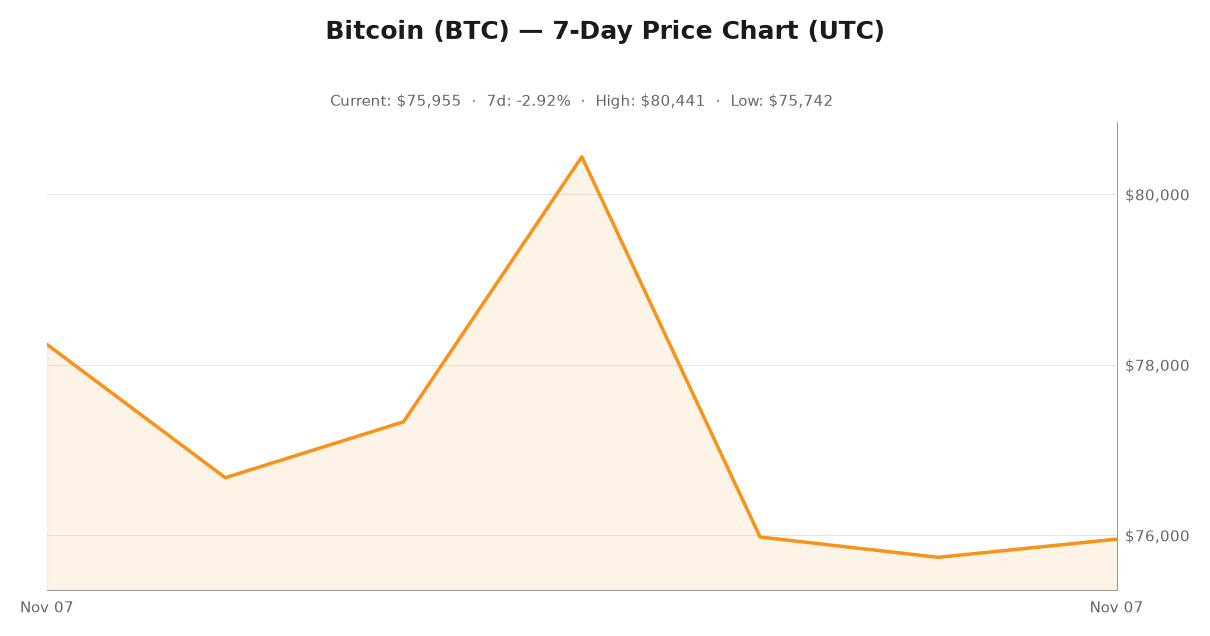
Bitcoin trades near $75,955 on Saturday, November 7, 2026 — roughly 5.6% below the $80,440 close it printed on November 4, after tagging a $74,790 low on Friday. Every crypto headline this week has been built on that slide, and on the surface it reads like a market that has lost its nerve.
It is also a misreading of what the Bitcoin futures market is telling you. Funding rates on the largest perpetual swap are barely positive, the quarterly curve is sitting in orderly contango, and the options market is pricing a return to quieter volatility after the ugliest week of the month. The Bitcoin futures complex watched a 5.6% drawdown happen and barely flinched.
That disconnect matters more than the price itself, so here is what the numbers actually show as of mid-morning UTC on November 7.
What Bitcoin futures did during the drop
First, this was a spot-led move, not a leverage unwind, and Bitcoin futures traders have priced that distinction clearly. A leverage-driven selloff has a signature: funding collapses into deeply negative territory, perpetual open interest gets liquidated, and the front of the futures curve flips into backwardation as shorts scramble to hedge. Almost none of that happened.
- OKX BTC-USDT perpetual funding: +0.00115% per 8 hours — roughly a 1.25% annualized rate, against the venue’s own 10.95% annualized interest-rate component. Funding this low means the long side is not paying up for the privilege of holding, and the short side is not paying to stay short.
- Perpetual premium: -0.046% — the swap trades slightly below spot and index, not at a premium.
- Last settled funding rate: -0.0000038 — the previous period was, in practical terms, flat.
- Deribit BTC-PERPETUAL open interest: $687.3 million on $1.20 billion of 24-hour turnover, with the perpetual marked at $75,965 — essentially spot.
Total open interest across the whole Bitcoin futures curve on Deribit sits at $1.21 billion. That book is what makes Bitcoin futures the most honest price-discovery venue in crypto right now. Read that again: more than a billion dollars of open Bitcoin futures positions, and the nearest expiries are priced within pennies of the index. When a market is genuinely stressed, the perpetual trades at a visible discount, funding goes deeply negative, and open interest evaporates. Here, none of that is true.
The curve is quietly paying about 5% a year to hold Bitcoin
The more revealing number is the shape of the curve. Spot at $75,955 against the listed contracts:
| Contract | Mark price | Open interest | Basis vs spot | Annualized |
|---|---|---|---|---|
| Spot (Kraken) | $75,955 | — | — | — |
| BTC-PERPETUAL | $75,965 | $687.3M | +0.01% | — |
| Nov 27, 2026 | $76,197 | $46.8M | +0.32% | ~5.8% |
| Dec 25, 2026 | $76,526 | $267.4M | +0.75% | ~5.6% |
| Mar 26, 2027 | $77,574 | $103.6M | +2.13% | ~5.6% |
| Jun 25, 2027 | $78,618 | $66.6M | +3.51% | ~4.9% |
| Sep 24, 2027 | $79,723 | $12.4M | +4.96% | ~4.7% |
That is a remarkably consistent staircase. Every expiry prices roughly 5% annualized carry — 5.6% for December, 5.6% for March, 4.9% for June, 4.7% for September. Bitcoin futures are not pricing a crash. They are pricing a carry trade. Somebody is paying up every quarter to hold long-dated Bitcoin exposure through September 2027, and the market is charging roughly 5% a year for the privilege.
That is a real yield, and it competes with cash and short-dated government debt for the same capital. It also explains why spot has not collapsed. The Bitcoin futures basis acts as a soft floor under the market, because every basis trade is mechanically somebody buying spot to hedge a short future. Carry is also the most crowded, most mechanical trade in crypto, and it works in reverse. More on that below.
The options market is the tell
Options reveal what traders think is possible, and Bitcoin futures options are pricing something very different from the panic narrative:
- ATM implied volatility for December 2026: 37.7% at the 76,000 strike. March 2027 sits at 39.3%, September 2027 at 40.3%.
- 30-day realized volatility: 35.9%. Seven-day realized volatility: 53.1%.
- Put/call open interest ratio: 0.70 — roughly 200,130 BTC of calls against 139,168 BTC of puts. The December 100,000 calls alone carry about 6,737 BTC of open interest.
- Downside protection is where the real conviction sits: the December 60,000 put is priced at 48.7% implied volatility with 6,667 BTC of open interest, the 50,000 put at 59.8%, the 40,000 put at 77.2%. On the upside, the December 100,000 call carries 41.3% implied volatility and the 150,000 call 62.7%.
Read those together and the message is clear. The options market is not pricing a regime change — it is pricing a return to normal after a genuinely violent week. The November 5 candle alone was a 5.5% fall, which is exactly why seven-day realized volatility is 53.1% while the 30-day figure is 35.9%. At 37.7% implied, December options are priced only modestly above the 30-day norm and a full 15 points below what Bitcoin just delivered.
Sellers of volatility are collecting a premium that assumes this week was an anomaly. That may be a good bet. It is also the most fragile position in the entire crypto market right now, and almost nobody is watching it.
Why this is not a flight-to-safety event
Two cross-checks confirm the calm in Bitcoin futures is not traders ignoring a bigger problem somewhere else, and not an artifact of illiquid Bitcoin futures pricing either.
- Bitcoin dominance fell 2.2 points to 59.31% over the past 24 hours while Bitcoin itself was essentially flat. Total crypto market cap sits at $2.57 trillion on $57.1 billion of 24-hour volume, and Ethereum trades at $2,243, up slightly. Capital is rotating into altcoins, not fleeing the market. That is risk-on behavior, not risk-off.
- The on-chain economy never panicked. Bitcoin’s mempool is clearing at 1 to 2 satoshis per virtual byte, and daily confirmed transactions came in at 414,323 on November 6 — down from a 913,196 peak inside the past 30 days, but nowhere near the disorderly spikes that show up during genuine fear.
Fees near zero, transactions grinding lower, dominance rotating down. This is a market without urgency, not one with too much.
The contrarian read: calm is the risk
So where does the risk actually sit? Three places, ranked by how much damage they would do.
- The volatility short. If realized volatility stays anywhere near the 53.1% seven-day figure instead of reverting toward the 35.9% 30-day average, implied volatility at 37.7% is simply too low. Options sellers have to buy back at higher prices, and that flow pushes implied volatility up into a market that is not expecting it.
- The carry unwind. That ~5% annualized Bitcoin futures carry is a crowded position. If Bitcoin rallies, funding flips from barely positive to aggressively positive and the basis trade flips from earning carry to paying it. The June and September Bitcoin futures are where that pain concentrates, since those contracts carry the largest dollar gap from spot.
- The headline gap. Bitcoin futures open interest of $1.21 billion, with a perpetual that traded $1.20 billion in a single day, means a lot of fast money sits on the book. A genuine catalyst — regulatory, macro, or liquidation-driven — reprices that book far faster than spot can absorb. The calm in Bitcoin futures today is precisely the setup for a violent move in either direction once somebody leans on it.
None of this means Bitcoin goes down. It means the derivatives market is priced for a boring range, and the part that looks calmest is the part holding the most convex instruments.
What to watch next
- Funding flipping hard. Anything beyond roughly +0.03% per 8 hours on the majors means the basis trade is getting crowded and the fuel is building.
- The November 27 quarterly future ($76,197 mark, $46.8 million open interest). If the front of the curve slips toward or below spot, the “no stress” read is dead.
- Implied volatility at the 60,000 strike. At 48.7% with 6,667 BTC of open interest, that is the market’s real opinion on a meaningful drawdown. Watch whether the bid holds.
- Perpetual open interest versus the $687 million mark, the cleanest single read on Bitcoin futures positioning. A 10% drop without a corresponding drop in spot means longs are being flushed — the first genuine stress signal.
- Bitcoin dominance. Another 2-point slide while spot goes sideways confirms rotation is absorbing supply rather than distributing it.
Live levels and open interest for the contracts discussed here are on Deribit, spot prices via Kraken, and market-wide totals from CoinGecko. Broader market coverage is on CoinDesk.
Bottom line
Bitcoin fell 5.6% in three days and the Bitcoin futures market shrugged. Funding near zero, a $1.21 billion open interest book, a curve paying about 5% a year, and options priced for calm rather than stress. Read that as resilience and you miss the setup: derivatives markets sitting calm right before a repricing are not resilient, they are unloaded. Watch funding, the front of the curve, and December implied volatility. Those three numbers will tell you long before the price does.