Bitcoin Mining at $76K: Difficulty Matters, Hashrate Lies
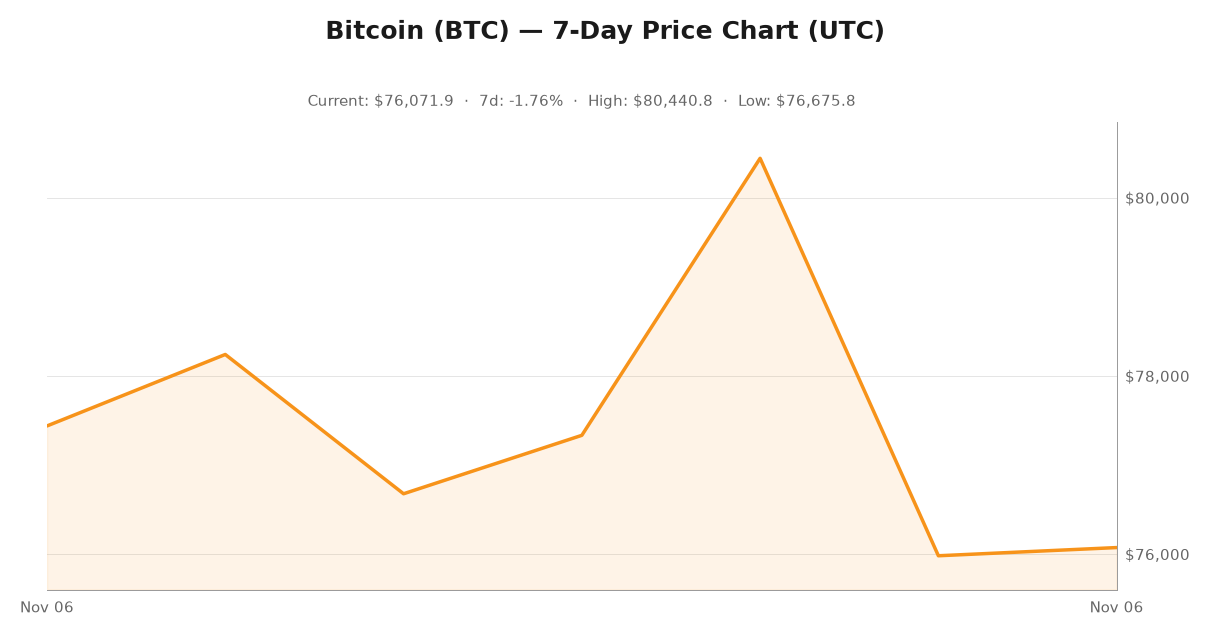
Bitcoin is trading around $76,070 this Friday morning, down roughly 5% over the past 24 hours, and nearly every headline in crypto is about price. I want to point the flashlight somewhere else: at the arithmetic inside the Bitcoin mining sector, because right now that arithmetic tells a sharper story than the chart does. Hashpower is near record territory, fees have collapsed to the floor, and the next difficulty adjustment is projected to come in lower. Put those three facts together and you get a market where the visible metric and the economic reality are pulling in opposite directions.
The November 6 data set
Everything below comes from public dashboards I pulled this morning, not from memory:
- Price: about $76,070 on the daily Kraken candle, market cap near $1.53 trillion, 24-hour change around -5.3%.
- Hashpower: 1,046 EH/s currently, a 90-day average of 966 EH/s, and 794 EH/s back on August 7.
- Difficulty: 148.36 trillion. The last adjustment was +5.54%. The next one, due at block 975,744 in about 947 blocks, is projected at -2.44%.
- Fees: recommended fee of 1 sat/vB at every tier on mempool.space, with median fees in recent blocks landing at 0.115 sat/vB or lower.
- Market share: Bitcoin dominance of 59.27% inside a $2.579 trillion total crypto market, per the CoinGecko global dashboard.
Fees are now a rounding error in the security budget
Run the subsidy math with me. At 144 blocks a day and 3.125 BTC per block, the network pays miners 450 BTC per day. At $76,070 that is roughly $34.2 million a day, or about $12.5 billion a year.
Now the fee side. Averaging the last 15 blocks, each one collects roughly 1.08 million satoshis, which at today’s price is about $818 per block. Scale that across a day and you land near $118,000, or $43 million annualized.
Do the division and you get this: transaction fees are supplying about 0.34% of total Bitcoin mining revenue. The other 99.66% is the block subsidy. Bitcoin mining economics are a subsidy story now, and fees are noise inside the security budget rather than a second revenue line. Plenty of commentary treats the fee market as the leading indicator of miner stress, but at these levels it is a rounding error, and the real stress has to be found somewhere else.
The hashprice squeeze that hashrate hides
Here is the number almost nobody quotes: implied revenue per unit of hashpower. Take daily subsidy revenue, divide it by current hashrate, and you get what a single exahash per second earns per day.
- August 7, 2026: 450 BTC x $64,886 = $29.2 million a day across 794 EH/s, so roughly $36,800 per EH/s per day.
- November 6, 2026: 450 BTC x $76,070 = $34.2 million a day across 1,046 EH/s, so roughly $32,700 per EH/s per day.
Bitcoin is up about 17% since that August snapshot. Hashpower is up about 32%. Implied revenue per unit of hashpower is down about 11%. That is the squeeze, and it is the single most useful fact I have for understanding Bitcoin mining right now.
Over the summer, roughly 252 EH/s of new hashpower came online into a rising market, and the revenue each machine generates fell anyway, because capacity arrived faster than price. Somebody financed that capacity at prices that no longer pencil out today. Every Bitcoin mining fleet added since July is running on a thinner margin than the ones already online, while the headlines announcing record hashpower describe the problem, not the health.
For anyone running machines, the question that matters is not how much hash you have. It is what each unit of hash earns per day. Bitcoin mining revenue per exahash is the honest version of the hashrate headline, and it has been sliding for months.
Difficulty is about to admit something
This is where Bitcoin mining economics turn into a real signal. Difficulty was raised 5.54% at the last adjustment while price has since fallen away. The next adjustment, around block 975,744 in roughly 947 blocks, is projected to come in at -2.44%.
Here is what a negative retarget means mechanically: enough hashpower has left the network that the difficulty target came down. That is Bitcoin mining capitulation showing up in the one number that cannot be spun. Daily hashrate bounces around constantly, and the 90-day range here ran from 782 EH/s to 1,228 EH/s, which is ordinary noise. Difficulty only moves when aggregate economics move, and only once every 2,016 blocks. Bitcoin mining difficulty is the scoreboard that settles arguments the hashrate chart cannot.
So watch the retarget instead of the estimate. A single -2.44% print is noise. Two consecutive drops, especially with hashrate sliding below 900 EH/s, would be a regime change for Bitcoin mining: less revenue per machine, less competition for the remaining reward, and eventually a lower difficulty-adjusted security baseline that markets price far in advance.
Why cheap fees are not automatically a bear case
Here is the contrarian part. A fee market sitting at 1 sat/vB sounds like a network nobody wants to use. I read it the other way: it means the product Bitcoin sells, cheap and reliable settlement, is currently priced near zero, and blockspace demand is not the constraint on adoption right now. That is why on-chain batching, Lightning routing, and exchange settlement keep getting cheaper, and it is a large part of why institutional plumbing can sit on top of the chain without users noticing the cost. Bitcoin mining revenue does not care why blockspace got cheap.
The uncomfortable counterpoint is that none of that cheapness pays for security. The subsidy funds the machines, and the next halving takes it from 3.125 BTC to 1.5625 BTC per block. If fees stay at a third of one percent of revenue, Bitcoin mining has to be funded by price appreciation alone, which makes sector health a pure function of where Bitcoin trades. That is a strange dependency for an asset whose pitch is that it is not a company, and it is exactly why the security budget debate keeps coming back.
There are proposals circulating, from covenant designs to OP_CAT, aimed at making blockspace demand more durable. None are close to consensus, and I would not build a thesis on any of them. What they do tell you is that the fee market question is being treated as a protocol-design problem rather than a solved one.
What I am watching next
- Difficulty, not hashrate. Two straight negative retargets would confirm the squeeze is now removing capacity for Bitcoin mining, not just compressing margins on paper.
- Fee revenue as a share of the block. For the fee market to matter again it needs to clear roughly 10% of miner revenue, which from today’s base means fee dollars rising about 30x. That is a demand event, not a price event.
- Hashpower under 900 EH/s with difficulty still falling. That combination would say Bitcoin mining capitulation is real and that marginal capacity is switching off rather than subsidizing the network from its own balance sheet.
- Power prices and pool concentration. When Bitcoin mining margins compress, the cheapest power wins and block production concentrates. Track where blocks are actually being mined and who is selling them using the mempool.space mining dashboard, the blockchain.info miner revenue series, and independent hashprice trackers.
Bottom line
Bitcoin mining is where Bitcoin’s risk actually shows up, and this week’s data says the sector is carrying more capacity on less revenue per unit than it was three months ago. Record hashpower hides an 11% decline in what each exahash earns. A -2.44% difficulty projection is the network starting to admit it. And a fee market contributing 0.34% of revenue means Bitcoin mining has become almost entirely dependent on the price of Bitcoin itself.
None of that is a reason to panic, and none of it is a reason to call the thesis broken. It is a reason to stop reading hashrate headlines as a health metric and start reading difficulty, fee share and revenue per exahash as the real scoreboard. For Bitcoin mining, this is a margin problem before it becomes a security problem, and the margin data turns negative before the security debate ever has to. For holders, that is a much better dashboard than another price prediction.