

Ethereum elevated post-quantum cryptography to a top strategic priority this month, forming a dedicated PQ team led by Thomas Coratger and announcing $1 million in prizes to harden hash-based primitives.
The announcement came one day before a16z crypto published a roadmap arguing that quantum threats are frequently overstated and premature migrations risk trading known security for speculative protection.
Both positions are defensible, and the apparent tension reveals where the real battle lies.
The Ethereum Foundation’s announcement frames PQ security as an inflection point. Multi-client consensus devnets are live, bi-weekly All Core Devs calls start next month to coordinate precompiles and account abstraction paths, and a comprehensive roadmap promises “zero loss of funds and zero downtime” during a multi-year transition.
Coinbase launched an independent quantum advisory board on Jan. 21, including Ethereum researcher Justin Drake, signaling cross-industry alignment around long-horizon planning.
Solana ran PQ signature experiments on testnet in December under Project Eleven, explicitly branding the work as “proactive” rather than emergency-driven.

Polkadot’s JAM proposal outlines ML-DSA and Falcon deployment alongside SNARK-based migration proofs.
Bitcoin’s conservative BIP-360 proposal for pay-to-quantum-resistant-hash represents an incremental first step constrained by governance realities.
The pattern resembles an arms race, but not one driven by an imminent threat.
This is a competition in institutional readiness, where the winner preserves fee economics, consensus efficiency, and wallet UX while upgrading cryptographic foundations before external pressure forces rushed coordination.
The harvest paradox
a16z’s core argument hinges on distinguishing harvest-now-decrypt-later risk from signature vulnerability. HNDL attacks matter when adversaries can intercept encrypted data today and decrypt it once quantum computers achieve sufficient scale.
That threat maps cleanly to TLS, VPNs, and data-at-rest encryption. Less so to blockchain signatures, which authenticate transactions in real time and leave no encrypted payload to store for future cracking.
Ethereum’s response implicitly accepts this framing but argues operational urgency remains high because changing signature schemes touches everything: wallets, account formats, hardware signers, custody infrastructure, mempools, fee markets, consensus messages, and L2 settlement proofs.
Migration requires years of lead time, not because quantum computers are imminent, but because the engineering surface is vast and failure modes are catastrophic.
NIST finalized its first post-quantum standards in 2024, FIPS 203, 204, and 205, and selected HQC as a backup key encapsulation mechanism while advancing Falcon and FN-DSA toward draft stages.
The EU issued a coordinated PQC transition roadmap in June 2025. These developments reduce “which algorithms?” uncertainty and make migration planning concrete, even if cryptographically relevant quantum computing remains distant.
Citi’s January 2026 report cites probability ranges for widespread breaking of public key encryption by 2034 and 2044, though many experts view CRQC in the 2020s as highly unlikely.
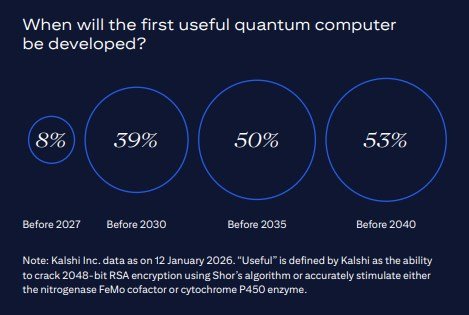
The timeline ambiguity doesn’t eliminate the planning imperative: it amplifies it, because chains that wait until threat signals are unambiguous will face compressed timelines and coordination chaos.
Signature bloat as the base-layer bottleneck
The immediate technical challenge is signature size.
ECDSA signatures consume roughly 65 bytes, which translates to approximately 1,040 gas under Ethereum’s calldata pricing model at 16 gas per non-zero byte.
ML-DSA candidates produce signatures in the 2-3 KB range, with Dilithium variants likely to see wide adoption. A 2,420-byte signature consumes roughly 38,720 gas just for the signature bytes, a 37,680-gas delta versus ECDSA.
That overhead is material enough to affect throughput and fees unless chains compress or aggregate signatures at the protocol level.
This is where Ethereum’s bet on hash-based cryptography and the $1 million Poseidon Prize becomes strategic. Hash-based signatures avoid the algebraic structure that quantum algorithms exploit, and hash functions integrate naturally with zero-knowledge proof systems.
If Ethereum can make STARK-based signature aggregation practical, it preserves fee economics while upgrading security assumptions. The challenge is that no practical post-quantum analogue to BLS aggregation exists yet, and zk-based aggregation introduce real performance constraints.
Consensus efficiency depends on this problem.
Ethereum’s consensus layer relies heavily on BLS signature aggregation today. Validators sign attestations and sync committee messages, and the protocol aggregates thousands of signatures into compact proofs.
Losing that capability without a replacement would force dramatic changes to consensus participation economics or liveness assumptions.

EF’s public emphasis on “lean” cryptographic foundations and interop calls coordinating multi-client PQ devnets suggests the organization understands aggregation is the hidden cliff.
| Signature scheme | Signature size (bytes) | Calldata gas @ 16 gas / non-zero byte | Delta vs ECDSA (gas) | Implication |
|---|---|---|---|---|
| ECDSA (secp256k1, r||s||v) | 65 | 1,040 | 0 | Baseline today |
| ML-DSA-44 | 2,420 | 38,720 | +37,680 | Fee + throughput shock |
| ML-DSA-65 | 3,309 | 52,944 | +51,904 | Aggregation becomes mandatory |
| ML-DSA-87 | 4,627 | 74,032 | +72,992 | L1 scaling pressure spikes |

Wallet UX as the social layer of cryptography
Protocol support alone doesn’t complete the migration.
Externally owned accounts can’t rotate keys cleanly under Ethereum’s current design. Users need one-click migration flows that don’t require deep technical knowledge. Hardware wallets must ship firmware updates. Custodians need a safe bulk migration tooling.
Ethereum researchers have explored key-recovery-friendly proof systems and seed-based migration approaches precisely to reduce coordination risk and UX friction.
a16z warns that premature migration introduces fragility, including immature implementations, shifting standards after deployment, and bugs in new cryptographic libraries.
The organization argues that current security issues, such as governance failures and software bugs, pose a greater immediate risk than quantum computers.
This is the crux of the “don’t panic” framing: migrating too early trades known security for speculative security, and the cost of getting it wrong is potentially higher than the cost of waiting for standards maturity and better tooling.
Both positions are defensible because they optimize for different failure modes. EF prioritizes avoiding rushed coordination under pressure.
a16z prioritizes avoiding self-inflicted wounds from hasty deployment. The divergence reveals the real battleground: chains that thread the needle, building migration infrastructure early without prematurely forcing users onto immature standards, will gain a competitive advantage.

Three scenarios, different winners
The migration timeline depends on external breakthroughs that no one controls.
In a slow-burn scenario where CRQC doesn’t arrive until the 2040s, migration occurs on a regulatory and standards cadence, prioritizing safety over speed. Chains that invested in crypto agility, with dual-signature periods, hybrid schemes, break-glass playbooks, can adapt without disruption.
In the base case where material quantum threats emerge in the mid-2030s, today’s work determines outcomes. If the ecosystem wants smooth transitions by 2035, wallet tooling and aggregation research must be production-ready years earlier.
This is the scenario EF’s roadmap optimizes for, and the one where multi-year lead times justify current investment.
In a fast-shock scenario where breakthroughs signal credible risk before 2030, the differentiator becomes how quickly a chain can freeze exposure, migrate accounts, and maintain liveness. a16z argues this outcome is unlikely, but the organization’s emphasis on planning suggests even low-probability tail risks justify preparation.
Triggers to watch include credible demonstrations of error-corrected scaling, logical qubit stability, and sustained gate fidelities. NIST or major governments advancing migration deadlines, and major custodians shipping PQ-capable signing in production.
None are imminent, but all would compress decision timelines.
| Battleground layer | Why it matters | What EF’s push signals | a16z “don’t panic” counterpoint | KPI to watch |
|---|---|---|---|---|
| Planning & crypto agility | Migration is a multi-year program; the failure mode is rushed coordination under pressure | Dedicated PQ team + governance cadence (PQ ACD) = treating migration as a protocol program, not a research thread | Premature shifts can increase risk (immature libs, shifting standards, new bugs) | Existence of a published chain roadmap + clear “break-glass” plan + staged rollout milestones |
| Wallet UX & account migration | Users won’t migrate unless it’s near-frictionless; EOAs are the long tail | Emphasis on account abstraction paths + “zero downtime / zero loss” messaging = UX is central | Avoid forcing users onto new schemes too early; UX failures become self-inflicted losses | % of wallets/custodians supporting dual-sign / key rotation flows; time-to-migrate for non-technical users |
| Aggregation & fee economics | PQ sigs can be large; without aggregation you lose throughput and raise fees | LeanVM + hash/zk foundations + devnets imply the bet is protocol-level compression | Even “correct” PQ can be unusable if it breaks economics; don’t trade usability for theoretical safety | Demonstrated signature aggregation performance (proof size/verification time) and resulting cost per tx/attestation |
| Consensus efficiency & validator overhead | Ethereum’s consensus relies on aggregation today; losing it threatens liveness/economics | Multi-client PQ consensus devnets + interop calls = treating consensus as the hard part, not just wallets | New consensus crypto is high-risk engineering; conservative rollout beats rushed redesign | Measured bandwidth/CPU overhead per validator vs today; attestation inclusion rates under load |
| Interop & standards maturity | Standards reduce “which algorithm?” uncertainty; ecosystems converge on safer choices | Prizes + workshops + external alignment (advisory boards) = ecosystem coordination | Wait for standards/implementations to mature before forcing mass migration | NIST/EU milestone alignment; shipping PQ support in major libraries/HW wallets without critical CVEs |
The new status game
Post-quantum readiness is becoming an institutional credibility metric, following the same path L2 maturity took in previous cycles.
Chains without credible PQ roadmaps risk being perceived as unprepared for long-term settlement assurance, even if the immediate threat is distant.
This dynamic explains why Solana, Polkadot, and Bitcoin all have active PQ workstreams despite the absence of imminent Q-day consensus.
The arms race isn’t about who flips PQ first. Instead, it’s about who preserves UX, fee economics, and consensus efficiency while doing it.
Ethereum’s approach bets on hash-based foundations, zk aggregation, and governance coordination.
Solana’s high-throughput architecture makes signature overhead particularly acute, forcing design innovation.
Polkadot’s heterogeneous sharding model allows per-chain experimentation.
Bitcoin’s conservatism reflects governance constraints and a long tail of legacy outputs that can’t be migrated without owner cooperation.

If PQ becomes the next L1 arms race, the winner won’t be the chain that announces the most prizes or devnets. It will be the chain that ships a migration path normal users actually complete, preserves throughput despite multi-KB signature candidates, and replaces today’s aggregation assumptions without sacrificing liveness.
The planning layer, wallet UX layer, and aggregation layer are now the real battleground, and the clock started years before most participants realized the race had begun.


