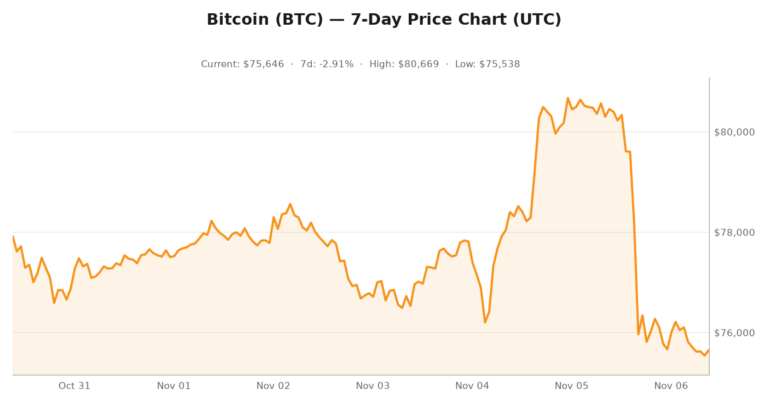
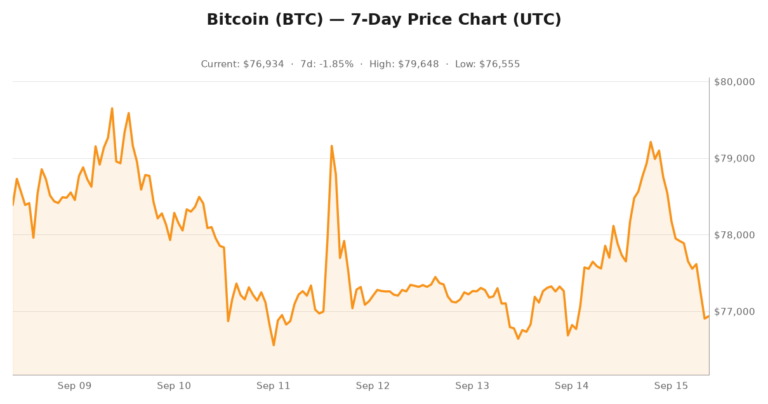
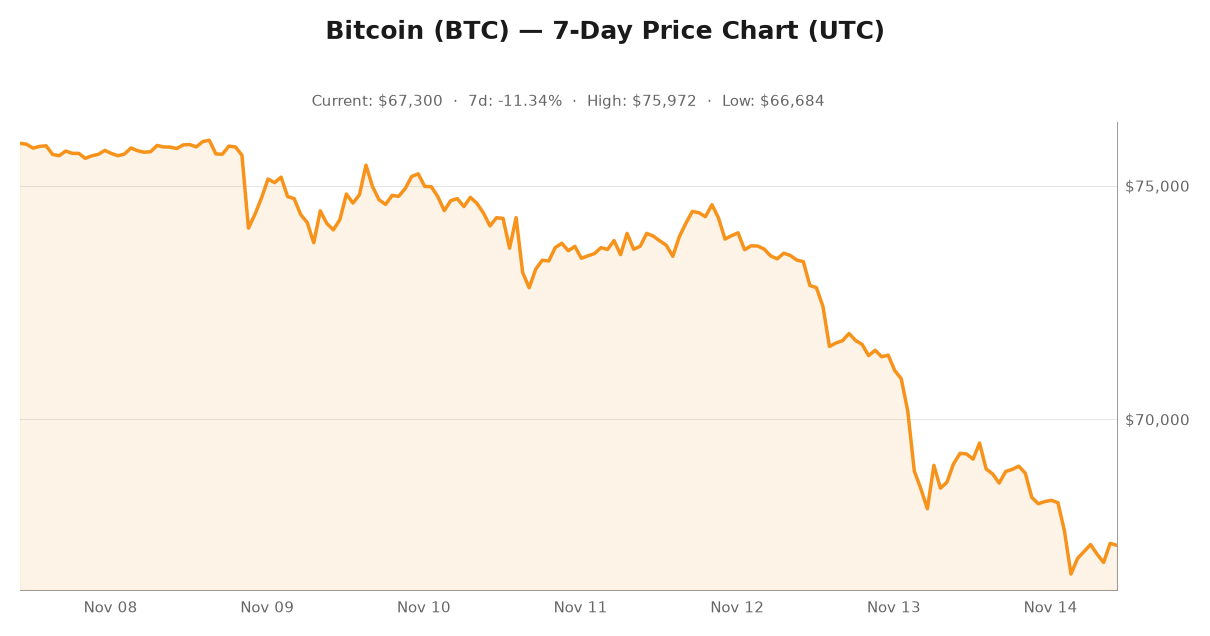
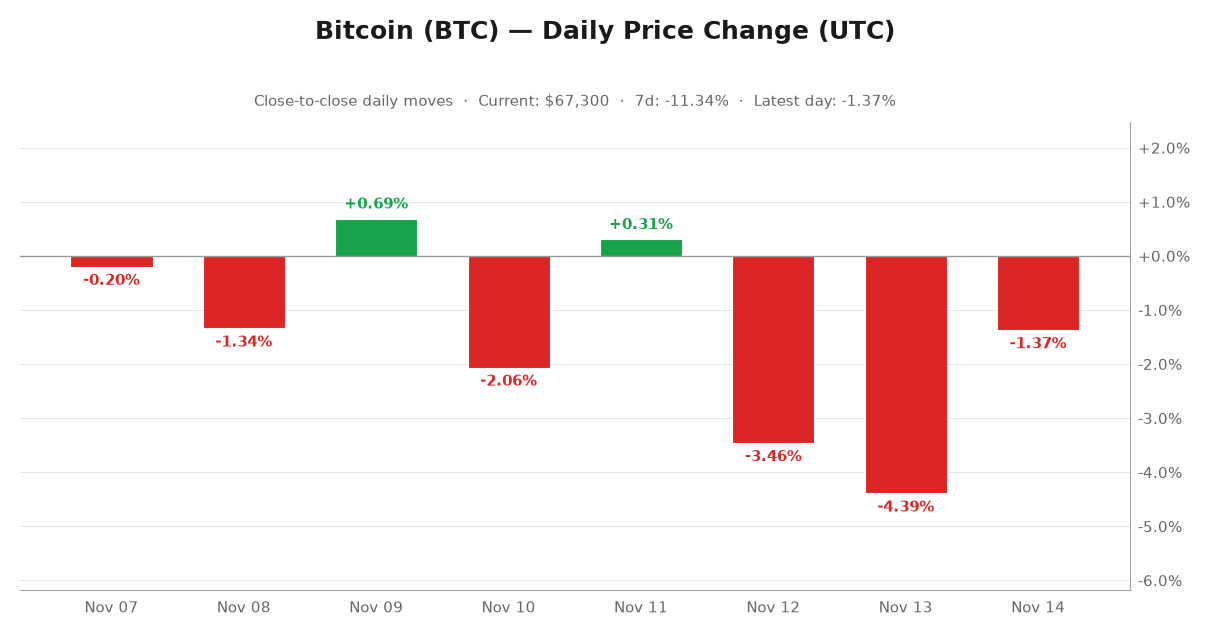
Bitcoin trades around $67,336 as of Saturday, November 14, 2026, down roughly 2.5% over 24 hours on a market capitalization near $1.35 trillion. Price is the headline, but it is not the most interesting number on the board. Underneath the tape, the market that pays for Bitcoin’s security is being repriced in real time, and almost nobody is watching it.
The setup is this: the network is still running at roughly 913 exahashes per second and current difficulty sits near 134.8 trillion. Yet at 05:02 UTC this morning, Bitcoin’s difficulty was cut by 9.13%, and the next adjustment is currently projected to fall another 6.0% around November 29. Two consecutive cuts do not describe a network that is getting meaningfully weaker. They describe a mining business whose margins have been squeezed hard enough to start retiring expensive hash.
That distinction is worth more than the headline. Most people read “difficulty down” as “network dying,” while the data says something more useful: the cost base for Bitcoin’s security is falling, and the miners still operating are about to earn more per unit of work.
What the Bitcoin network looks like on November 14, 2026
The Bitcoin mining market only makes sense when you separate four variables: hashrate, or how much computing power is running; difficulty, the price the network charges that computing power; hashprice, the revenue each unit of computing power captures; and fees, the slice of revenue paid by users instead of the block subsidy.
The five numbers that matter
- Current hashrate: about 913 EH/s, with a 7-day average near 903 EH/s and a 30-day average near 1,012 EH/s (mempool.space mining dashboard).
- Current difficulty: roughly 134.8 trillion, after a 9.13% cut at 05:02 UTC today. The next adjustment, at block 977,760, is presently projected at -6.0%.
- Daily miner revenue on November 13: about $26.45 million, down roughly 46% from about $48.63 million a year earlier (blockchain.com’s on-chain charts).
- Daily transaction fees on November 13: about $269,000, or roughly 1% of miner revenue.
- Confirmed transactions on November 13: about 422,900, versus roughly 449,600 a year earlier.
Put those numbers side by side and the story is not a collapse in security spending. It is a collapse in the return on that spending. The Bitcoin chain is still doing roughly 913 EH/s of work. It is simply paying that work about a third less than it did a year ago.
The hashprice squeeze is the actual headline
Hashprice is the cleanest gauge of mining stress: total miner revenue divided by total computing power, expressed per petahash per day. Using the latest available daily revenue figures alongside current hashrate estimates, the squeeze is stark.
What $29 per petahash actually means
- Now: roughly $29 of revenue per petahash per day.
- A year ago: roughly $45 per petahash per day.
- Change: about -35%, even though the price of Bitcoin is down only about a fifth over the same stretch.
That gap is the whole story. Hashrate fell far less than revenue did. blockchain.com’s own estimator shows hashrate roughly 23% lower than a year ago (833 EH/s versus 1,085 EH/s on November 12, 2025), while revenue per unit of hash fell about 35%. Miners did not get paid less because the network stopped working. They got paid less because the price of Bitcoin collapsed faster than their own costs.
Electricity is usually the biggest line on a miner’s ledger, and it does not care what Bitcoin did this week. That is what makes the sequence of difficulty cuts predictable: fleets running older or more expensive hardware go offline first, the Bitcoin network reprices hash downward, and the survivors capture a larger share of the remaining reward. This is the same clearing mechanism that ran through Bitcoin’s 2022 and 2023 drawdowns. It is ugly while it happens, and it is not, by itself, a bear signal.
Why Bitcoin’s fee market cannot bail out miners
The usual rebuttal is that transaction fees will replace the shrinking subsidy. For now, the numbers reject that argument outright. On November 13, Bitcoin’s fee market generated about $269,000, worth roughly 4 BTC. That was about 1% of the $26.45 million miners collected that day.
A busy queue with no pricing power
The queue is not even empty. At the time of this check, the mempool held about 62,400 transactions and roughly 30.5 million virtual bytes, carrying about 5.83 million satoshis in total fees, or about $3.9 million at current prices. That works out to an average near 0.19 satoshis per virtual byte, and the fee histogram shows the bulk of the queued bytes priced at 0.12 sat/vB or less.
A backlog with no pricing power measures demand quality, not a fee boom. Thousands of cheap, low-value transactions can pile up without moving miner economics at all. Until the average Bitcoin fee rate climbs into multiples of the current sub-satoshi floor, fees are noise in a miner’s profit-and-loss statement rather than a rescue plan.
Falling difficulty is not a failing network
Here is the contrarian case, and the data supports it. Difficulty is not a health score. It is a clearing price for hash. When hashprice falls below the cost of operating marginal hardware, that capacity shuts down, Bitcoin’s difficulty resets lower at the next retarget, and the surviving miners earn more per unit of hash at the same price. Difficulty cuts are the mechanism working, not the problem.
There is a second force pushing in the same direction: speed. During the current adjustment window, blocks have been arriving about every 8.35 minutes, comfortably ahead of the 10-minute target. When blocks come in early, the Bitcoin network produces more of them than expected over the adjustment period, which mechanically lowers the next difficulty. Combine early blocks with thin margins and you get the -6.0% projection sitting on the dashboard for block 977,760, estimated for Sunday, November 29, 2026.
What would invalidate the thesis
If hashrate falls in step with difficulty instead of holding steady, that would point to capitulation instead of healthy pruning. The recent range bottoms around 780 EH/s, so a sustained break below that zone would be new information rather than noise. A second warning sign would be fee revenue rising while the subsidy’s dollar value keeps falling, because that combination would mean the Bitcoin security budget is quietly shifting from miners to users.
Four numbers to watch before November 29
- The 7-day average hashrate versus the 30-day average. Right now it is about 903 EH/s against about 1,012 EH/s. If the short average holds while difficulty is cut, economics improve for the machines that stay. If the short average follows difficulty down, miners are leaving.
- Implied hashprice. At roughly $29 per petahash per day, revenue per unit of computing power is close to where the least efficient fleets stop covering power and overhead. A slide back toward the low $20s would accelerate shutdowns.
- The fee share of miner revenue. It sits at about 1%. A sustained climb into the double digits would change the sector’s economics more than any difficulty print, because it would diversify revenue away from a subsidy that does not move until 2028.
- The retarget projection itself. A -6.0% projection is already severe. If it moves toward flat or positive before November 29, blocks have slowed enough for hash to re-accelerate, and the stress is easing faster than the current estimate implies.
What this means for Bitcoin investors
- Do not trade difficulty like a price indicator. It is a cost reset driven by miner economics, not a signal about demand for Bitcoin itself.
- Watch miner balance sheets, not headlines. The relevant question is who can still cover power costs at current hashprice. CoinDesk’s Bitcoin mining coverage is the best place to track the operating picture.
- A lower cost base can be quietly bullish. If prices hold around current levels and fees begin to recover, miner economics improve twice over: fewer competitors chasing the same reward, and a slightly larger fee contribution per block.
- Spot volume still tells you what miners are doing. The asset was trading around $67,336 with roughly $33 billion in 24-hour volume, according to CoinGecko’s market page. Persistent sell pressure alongside falling hashprice would be the combination worth worrying about; the current setup looks more like quiet pruning.
The bottom line
The mining market is being repriced, not broken. Difficulty has already been cut 9.13% and is heading for another 6% cut, hashprice is down about 35% year over year, and fees still cover only about 1% of what miners earn. Read carelessly, that is a story about decay. Read correctly, it is a story about expensive hash being retired while roughly 913 EH/s keeps securing the chain.
For investors, the practical takeaway is simple: watch the gap between hashprice and power costs, not the difficulty headline. When that gap heals, the next mining cycle starts from a much lower cost base than the one that produced the last one. Until then, expect more volatility in miner revenue than in Bitcoin itself.
For current price, market cap, and volume, see CoinGecko. For live hashrate, difficulty, and fee data, see the mempool.space mining dashboard.