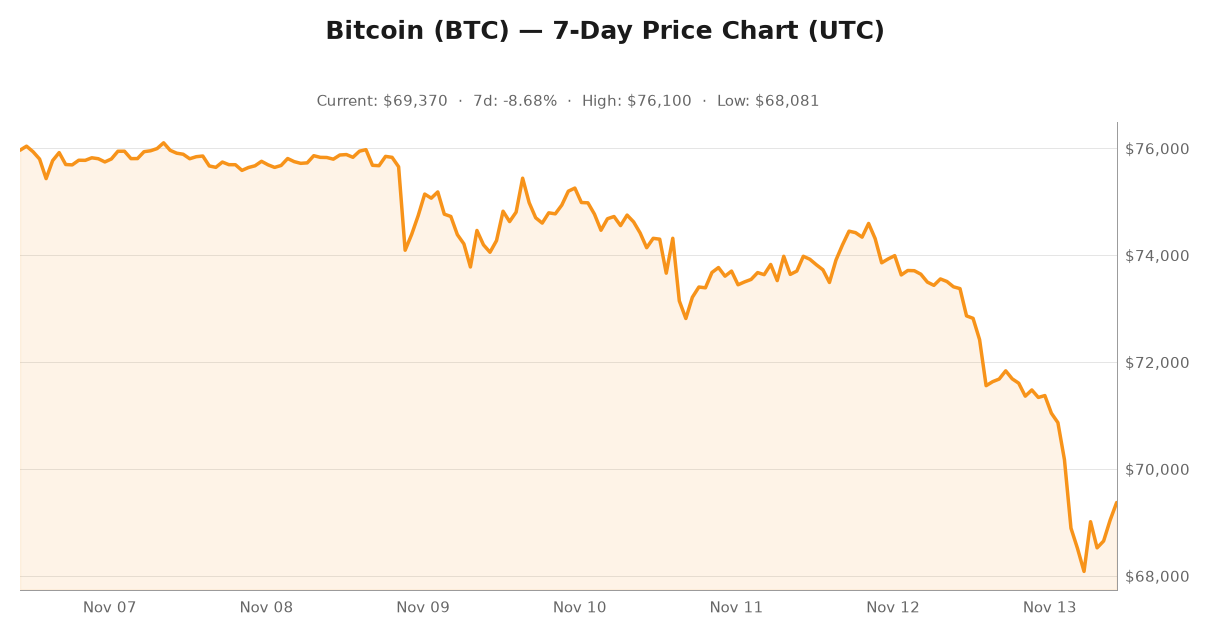
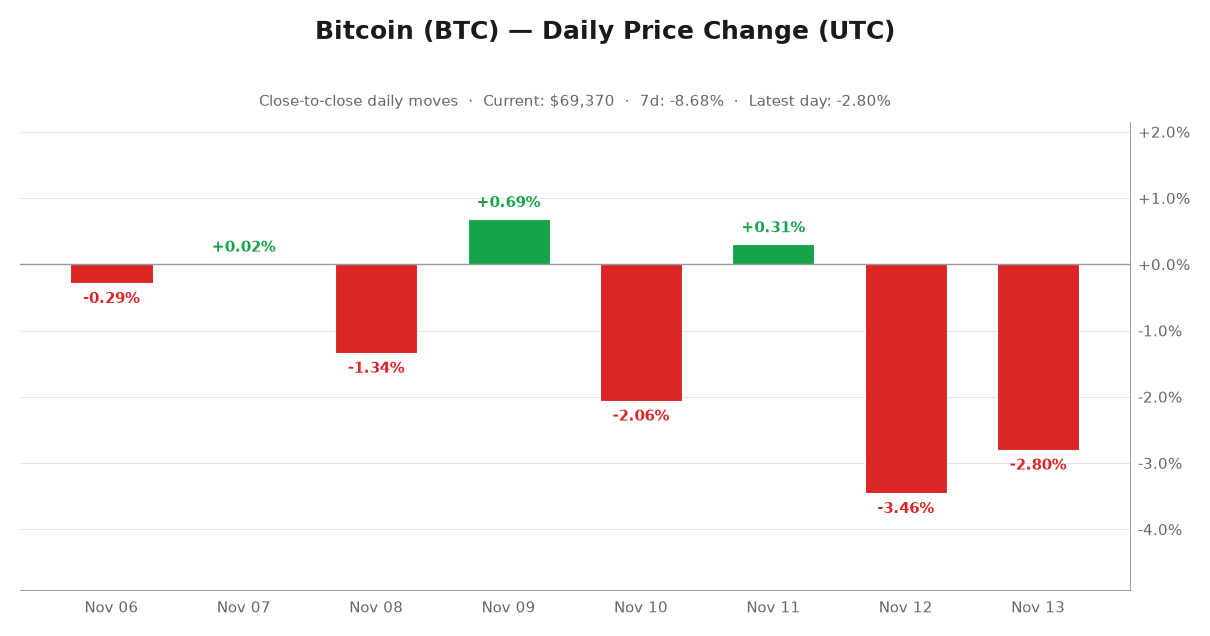
Something odd happened in crypto derivatives on November 13, 2026, and almost nobody flagged it. Bitcoin slid roughly 6% to about $69,000, Ether fell to near $1,940, and liquidation alerts lit up across trading desks. That part is routine. What was not routine was where the leverage actually sat.
Hyperliquid, the on-chain exchange running its own app chain, processed roughly $9.86 billion in perpetual futures volume across 235 listed markets in the trailing 24 hours, carried about $6.5 billion in open interest, and accounted for roughly $220.5 million of the $221.6 million in tracked crypto liquidations, according to DeFiLlama. That is about 99% of the total, from one venue.
Now put those numbers beside the incumbent. OKX’s flagship BTC-USDT-SWAP did about $11.8 billion of volume in the same window, but its open interest was $2.39 billion. Hyperliquid’s Bitcoin perpetual alone carried $2.70 billion, more than OKX’s flagship swap, on a venue most of the industry still files under “interesting crypto experiment.”
The bullish read is that crypto leverage has a new home. The contrarian read is that the numbers do not support the loudest version of that story. Here is what the tape says.
The day the numbers changed the argument
Bitcoin was down about 5.95% over 24 hours to $69,043 and Ether was down about 5.14% to $1,939, per CoinGecko. On Hyperliquid’s Bitcoin perpetual, the session opened near $71,448, wicked down to $67,474, and sat near $69,200 when this was written. Nine days earlier that perpetual candle peaked at $81,177, so Bitcoin is roughly 15% below that high. Leverage traders have had a rough two weeks, but not a disorderly unwind.
Hyperliquid’s 24 hours, in six numbers
- $9.86 billion in 24-hour perpetual futures volume across 235 markets
- $5.88 billion of that volume in the Bitcoin perpetual, about 60% of the total
- $2.70 billion in BTC perpetual open interest, versus $2.39 billion in OKX’s BTC-USDT-SWAP
- $1.91 billion of Ether perpetual volume and $1.44 billion of ETH open interest
- 235 perpetual markets, 351 spot pairs and 516 spot tokens listed
- $2.33 billion locked on the Hyperliquid L1 chain, seventh among all chains tracked by DefiLlama
The token mix says the same thing. HYPE pulled $557 million of perpetual futures volume and $1.57 billion of open interest, Zcash perps did $523 million, Solana $311 million. About 60% of the flow is Bitcoin.
One comparison makes the scale concrete: spot volume across every decentralized exchange DefiLlama tracks was about $8.12 billion in the same 24 hours, with Uniswap v3 at $1.74 billion. Hyperliquid’s perpetual futures book did more than the entire tracked spot DEX market. On-chain derivatives is no longer a rounding error attached to on-chain spot. It is the larger half of it.
It now matches OKX’s flagship Bitcoin swap
The open-interest comparison should make market structure people uncomfortable. OKX’s BTC-USDT-SWAP carried $2.39 billion of open interest at $69,168, having traded 170,706 Bitcoin, roughly $11.8 billion, in a day. Hyperliquid’s Bitcoin perpetual carried $2.70 billion of open interest on $5.88 billion of volume. One on-chain venue now holds more Bitcoin swap open interest than a major exchange’s flagship swap while trading half the volume. The liquidity holding is not the liquidity churning.
The venues are not interchangeable yet: OKX still clears more Bitcoin volume per day. Hyperliquid is winning the balance-sheet business, the open interest that stays on the book, rather than the flow business.
Almost every liquidation in crypto happened on one chain
Total tracked crypto liquidations over the last 24 hours were $221.6 million, up 311% from the prior day, and Hyperliquid accounted for $220.5 million of it. Every other venue combined accounted for roughly $1.1 million. Against the seven-day figure of $892 million, the daily average is about $127 million. Today was 1.7 times that average, and virtually all of it cleared on one venue running one liquidation engine.
Why concentration is the real story
That is a mark of dominance and a concentration risk nobody prices correctly. When nearly all liquidation flow funnels through one chain, that chain’s block production becomes a systemic variable rather than a venue detail. A two-minute stall on Hyperliquid’s app chain would leave the market nowhere to execute liquidations, because that is where the collateral is marked.
Funding stayed flat, and that is the interesting part
Funding is where positioning shows up, and on November 13 it barely moved. Bitcoin perpetual futures funding printed at 0.00125% per hour. Ether came in at 0.00117%. HYPE was 0.00125%.
Reading the baseline rate
To read those prints you need the baseline. Hyperliquid’s documentation sets the interest rate component of funding at 0.01% every eight hours, which is 0.00125% every hour and an 11.6% annualized rate paid to shorts, with the remainder reflecting the premium or discount between the perpetual futures contract and the spot oracle price. The documentation is explicit about that premium component.
So when Bitcoin funding prints at exactly 0.00125%, the premium component is sitting at zero and the perpetual futures contract is trading at the spot oracle. No premium, no euphoria, no “everyone is long” fingerprint on a day the underlying fell nearly 6% and liquidations rose more than threefold. That is orderly deleveraging. Positions were closed, not capitulated.
Two exceptions prove the point. Monero funding was negative at -0.00212%, and it is the one board where the perpetual traded below spot. Everything else was flat or a hair below. When funding does not move, the price move is driven by spot sellers rather than a leverage unwind. This drawdown was demand, not a cascade.
The quiet explosion: builder-run perpetual futures
The most underreported number was not Hyperliquid’s Bitcoin volume. It was XYZ, a builder-deployed perpetual DEX running on Hyperliquid’s chain. DefiLlama puts its open interest at $4.33 billion, larger than Hyperliquid’s own $2.70 billion Bitcoin perpetual book. XYZ trades equity and commodity contracts: Apple, Amazon, AMD, Arm, ASML, Alibaba and aluminium, each with a self-imposed open-interest cap from $25 million to $250 million.
The point is not that crypto traders suddenly want Apple exposure. The point is that Hyperliquid’s HIP-3 upgrade made perpetual markets permissionless. Any builder can deploy a perpetual futures market, set its caps and let traders list it. That is a structural change in how derivatives get distributed, and it happened without a major exchange announcing anything. A perpetual on a basket or a niche asset no centralised exchange would touch is now deployment rather than negotiation.
What the fee data says, and what it does not
Here is where it gets uncomfortable for the bulls. Hyperliquid’s fee revenue over the last 24 hours was $2.71 million. Over 30 days it was $86.25 million, an implied daily average of about $2.87 million. On a day with $9.86 billion of perpetual futures volume and a 311% jump in liquidations, the venue took slightly less money than an ordinary day.
The headline volume number overstates how much cash actually changed hands, and any article quoting volume without the fee take is quoting half the story. A maker-heavy mix and a slice of flow in builder-deployed perpetual markets with different fee structures could explain the gap. Volume and value capture are separate businesses, and only one pays for infrastructure.
Why Bitcoin traders should care
Bitcoin’s derivatives market now has three layers: CME for institutional basis, offshore perpetual futures venues for size, and on-chain perpetual futures like Hyperliquid’s for speed and transparency. Each prices the same Bitcoin, and when they disagree, capital moves. Three consequences for anyone holding Bitcoin:
- Liquidation now has a single address. Nearly all of it. If you are leveraged on Bitcoin, your exit is increasingly marked against an oracle clearing on Hyperliquid’s app chain, with its own validator set and its own downtime risk.
- Funding is a cleaner signal than before. Because on-chain funding resets hourly and tracks the spot oracle closely, a print of exactly 0.00125% is a precise statement about positioning. It told you this drawdown was spot-driven, not a leverage cascade.
- New venues mean new basis. When a builder-deployed perpetual market carries $4.33 billion of open interest on instruments the offshore exchanges do not list, the assumption that Bitcoin leverage trades in two or three places fails. Basis dislocations between venues are the predictable result.
The three risks nobody is pricing
- Engine concentration. A share of tracked liquidations near 99% on one chain is a single point of failure with a very large blast radius.
- Thin collateral against fat books. $6.5 billion of open interest and $9.86 billion of daily turnover sit on $2.33 billion of chain TVL. If collateral is pulled or depegged, the liquidations that follow will be forced rather than orderly.
- Permissionless market operators. The same tooling that let a builder list a perpetual on Apple can list one with a weaker oracle or thinner liquidity. The permissionless part cuts both ways.
What to watch next
- Whether Hyperliquid’s Bitcoin open interest keeps exceeding OKX’s flagship swap through the next volatility window.
- Whether fee revenue follows volume. If it does not, the volume is churn, not balance sheet.
- Whether the liquidation share stays near 99%, and what happens the first time it does not.
- Whether builder-deployed perpetual futures keep growing, because that part has no centralised equivalent.
Bottom line
Bitcoin is down, leverage got shaken out, and the most interesting thing that happened was structural rather than dramatic. Hyperliquid handled roughly $9.86 billion of perpetual futures volume, held more Bitcoin swap open interest than OKX’s flagship contract, and processed nearly all of crypto’s liquidations in a day. Positioning data says this drawdown came from spot selling rather than a leverage cascade, which is a healthier way to lose 6%. The honest caveat is that the fee take did not follow the volume.
Watch the open interest, not the volume. That is where the next answer is.