Bitcoin’s UTXO set just printed an all-time low: 164,490,680 unspent outputs on November 12, 2026. That is the smallest the set has ever been, 13.1% below the December 2024 peak of 189,330,247. Most market commentary reads a shrinking UTXO set as a bearish supply statistic. The data on the ground says something closer to the opposite, and the fact that miners capitulated into the same week makes the case stronger, not weaker.
Here is the setup. Bitcoin trades near $73,900, roughly 41% below its October 2025 high of $124,776. Transaction counts are down a third in a month. Yet the value sliding across the network per day is rising, and the raw inventory of spendable coins keeps shrinking while total supply does not move. That combination is what consolidation looks like from the inside of a cycle.
Five numbers tell the story, and none of them have been in the news yet.
What Bitcoin’s UTXO set actually measures
Every spendable piece of Bitcoin sits in an unspent transaction output, a UTXO. When a wallet pays for something, its inputs are consumed and a new output is created. If one wallet sweeps twenty old coins into a single new output, the UTXO count drops by nineteen, even though nothing was sold and no Bitcoin left the system.
So the UTXO set is not a measure of how much Bitcoin people hold, and it is not a direct measure of selling pressure. It is a measure of how finely or crudely the coin supply has been chopped up. That makes it an odd cycle indicator and a very good one. The Blockchain.com UTXO chart shows the set at 164,490,680 as of November 12, 2026, the lowest reading in the series. The trend has been steady rather than sudden:
- Last 7 days: -638,111 UTXOs (-0.39%), roughly 91,000 fewer per day
- Last 30 days: -1.61 million (-0.97%)
- Last 90 days: -2.56 million (-1.53%)
- Last 365 days: -3.01 million (-1.80%)
- Since the December 21, 2024 peak: -24.84 million (-13.1%)
None of that looks like panic. It looks mechanical. And it lines up with something else that has been quietly changing in parallel.
Why a shrinking UTXO set is consolidation, not capitulation
When Bitcoin prices fall for months, holders behave in a predictable way. They stop creating new outputs and start merging old ones. Wallets consolidate. Exchange deposit addresses get swept. Long-dormant coins move into fresh outputs so that expensive old transactions fall out of a wallet’s history. The UTXO set shrinks, and total supply does not budge.
Two numbers confirm that is what is happening here, rather than demand simply dying:
- Confirmed transactions per day fell to 565,571 on November 11, down 32.5% from 838,363 on October 13 and well off the 913,196 peak set on October 23.
- Estimated daily transaction value rose to about 103,873 BTC on November 11, against 89,948 BTC a month earlier and just 40,436 BTC in mid-September.
Fewer transactions, more value per transaction. That is a network consolidating balances, not a network hemorrhaging them. Unique active addresses tell the same quieter story: 471,396 on November 11, essentially flat against 478,223 on October 13, but still a long way below the 569,974 daily print from August 21. Activity is not expanding, it is concentrating.
There is a second-order effect that most people miss. A shrinking UTXO set means the average age of Bitcoin’s coin base is falling. Coins that sat untouched for years and then moved get re-denominated at today’s price. When that happens across a large slice of the supply, the cost basis under the market resets upward. A seller who bought at $20,000 and consolidated into a fresh $73,900 output in October no longer carries a loss to defend. A seller who bought at $90,000 and is still sitting on that coin does.
That is why an all-time-low UTXO set tends to show up near cycle lows instead of before them. The coins that would have been sold into weakness at the bottom have already been sold, or at least reorganized. The marginal seller at $73,900 is a different, more stubborn seller than the marginal seller at $95,000.
The 5 numbers that matter right now
- 164,490,680 UTXOs – an all-time low for the set, 13.1% below the December 2024 peak.
- -7.74% expected difficulty change at block 975,744, roughly 38 hours out. The previous retarget was +5.54%.
- 988 EH/s of hash rate as of November 11, down 20.4% from the 1,241 EH/s record set on November 26, 2025.
- $33.05 million in daily miner revenue on November 11, down 37.5% from the $52.93 million peak on October 5.
- 565,571 daily transactions carrying 103,873 BTC – the consolidation signature that the first number alone cannot show you.
Numbers one and two are the ones that matter most. The first says the supply side is cleaning itself up. The second says the security side is under pressure.
The miner math: a 7.7% difficulty drop is the tell
Bitcoin’s difficulty resets every 2,016 blocks, roughly two weeks. The mempool.space difficulty tracker currently shows the next retarget at block 975,744 coming in at -7.74%, with about 38 hours remaining. The last retarget went the other way, +5.54%, which means the network added serious hash power right before the market rolled over. Miners chased the October rally and are now paying for it.
The revenue math explains why. Daily miner revenue on November 11 was $33.05 million, down 37.5% from the $52.93 million peak set on October 5. Hash rate is down 20.4% from its record. And fees are still cheap: the mempool was quoting 4 satoshis per vByte for the fastest confirmation, 3 for the hour, and a 1 satoshi minimum as of Thursday. Block subsidy plus thin fees means the security budget is being funded almost entirely by issuance, which is exactly the regime where marginal miners capitulate.
And they are capitulating. A 7.74% difficulty cut is a large single-period move. It means fleets that were bid up to serve the October peak are being turned off now that the revenue per unit of hash has collapsed. Bitcoin market data on CoinGecko still shows total crypto market capitalization near $2.43 trillion with Bitcoin dominance at 33.2%, and Ethereum trading near $2,045 – Bitcoin is holding a third of a shrinking pie, which is a relative-strength signal in a bear tape.
Price action: the last seven days
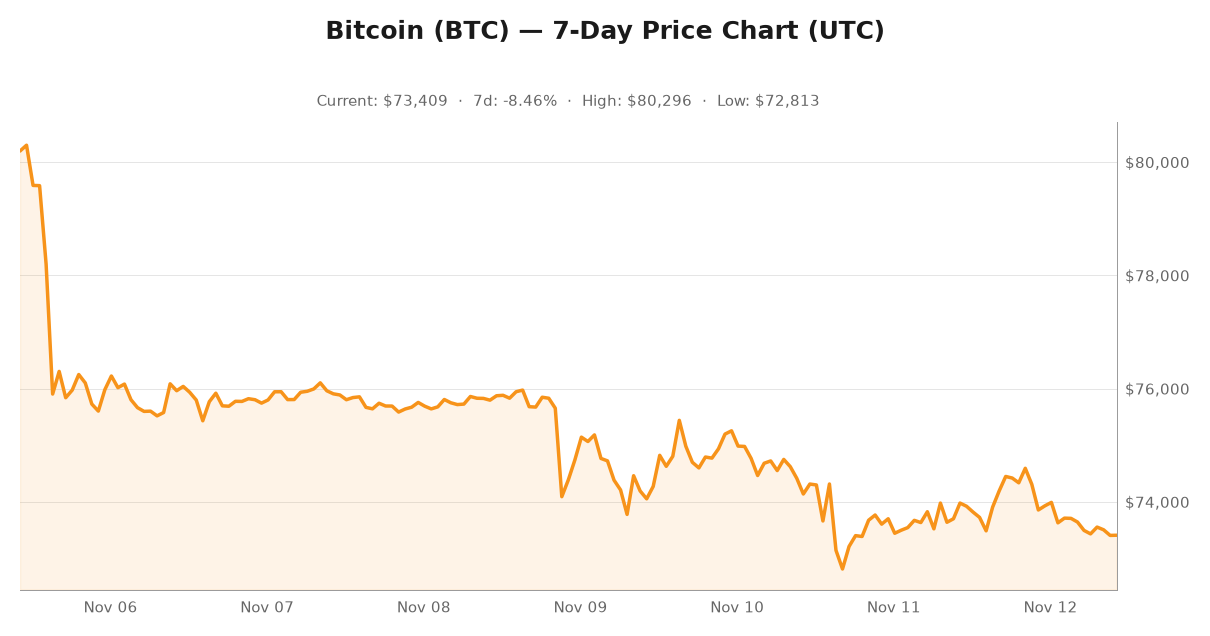
The chart below tracks the past week closely, and it has not been kind. Bitcoin closed November 5 at $80,413 and is printing around $73,930 on November 12, a decline of about 8% in five sessions. The bigger frame matters more: the asset is 40.7% below its October 7, 2025 all-time high of $124,776, and the 12-month low was $58,534 on July 1, 2026. That July low is the reference point. Bitcoin has recovered roughly 26% off the bottom and is now pushing back down toward the $70,000s, which is where a late-stage retest of the bear case would show up.
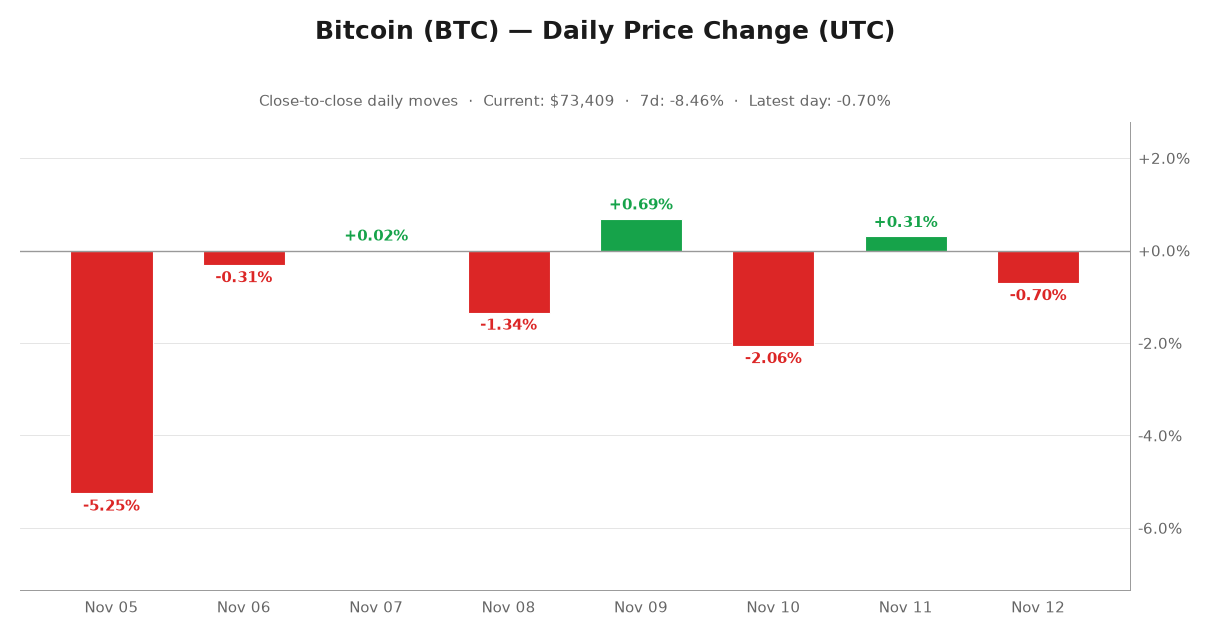
Two support zones matter for the rest of this week. The $73,000 area held through the first week of November, and the July low of $58,534 defines the floor of the entire bear leg. A clean break of $73,000 would open a path back toward the low-60,000s where the market bottomed. Holding it while the difficulty cuts and the UTXO set keeps grinding lower is the setup that ends a cycle. We covered the fee-market side of this in detail in our Bitcoin fees at 1 sat breakdown, and it is still the cleanest bull argument hiding in plain sight.
What would break this thesis
Consolidation is not a bottom by itself. It is a setup, and setups fail. Here is what would invalidate the read:
- A miner capitulation cascade. Hash rate is already down 20% from its peak. If the November 13 difficulty cut is followed by another sharp drop, selling pressure from miners forced to cover costs can overwhelm the consolidation story fast.
- Sustained ETF outflows. A shrinking UTXO set means fewer coins moving on-chain. If institutional demand keeps leaving the market, the coins that did consolidate will eventually have to be sold instead.
- A break of the July low. Below $58,534 the cost-basis reset argument loses its anchor, and Bitcoin re-enters price discovery with no historical support underneath.
- Fee collapse into zero. With fees at 1 satoshi and the block subsidy doing the work, there is no second revenue layer to soften a miner capitulation. That is the vulnerability in the structure right now.
And here is what would confirm it, in order of importance: the UTXO set bottoming and turning up, hash rate stabilising after the November 13 cut, daily transaction value holding above 100,000 BTC, and Bitcoin reclaiming $80,413 on expanding volume. Any three of those four and the consolidation thesis becomes a cycle-bottom thesis.
The bottom line
Bitcoin’s UTXO set is at an all-time low of 164,490,680, confirmed transactions are down a third month over month, and the difficulty is about to fall 7.74% in the largest single retarget of this cycle. Read alone, that is a bear tape. Read together, it is a network cleaning its inventory while its miners absorb the pain of a 41% drawdown – which is what the bottom half of every Bitcoin cycle has looked like from the inside.
Watch block 975,744, the UTXO count on the daily chart, and the $73,000 level. Two of those three turning up would tell you that the sellers are running out. The consensus is still that a retest of the lows is coming, and consensus has been wrong about Bitcoin bottoms before. The on-chain data is worth more than the narrative right now. Track it with us, and see the latest crypto market coverage while you wait.